'05 GMC ENVOY TPS throttle issues

manoftheearth

Member
Joined
Dec 21, 2022
Posts
29
Location
New Mexico
'05 GMC Envoy 4.2l L6

So, mice chewed the wires that connect to the pig tail that connects to the TPS along with the pig tail that is more recessed behind the throttle body assembly. I mended these connections with crimps and wire nut twists and the problem was fixed without any issues or alarms for 3 months. Now, the vehicle loses acceleration and power but remains on. I get both check engine lights. I restart the vehicle, the security check engine light goes off, the check engine light stays on, and the vehicle runs fine. The codes I get are P0442,P2135, and P2138. I will add that the current problem is different (but related) to the initial problem when the mice chewed the wires. Before the repair, the vehicle would start and idle but when you pressed the gas the vehicle would stutter and act like it was going to die and would not drive at all. Those codes were different, P0442 and P0122. The other confusing thing is the aftermarket stereo would stay on "stand by" and would not work or turn off when the vehicle was turned off which consequently killed the battery. I replaced the battery. The stereo turns on and off and works now. I can also tell that the alternator is going bad. All of these electrical issues are leaving me confused and I am wondering what is related and what is not. I honestly think that my electrical repair may be the issue even though all of the connections feel secure. I plan to go back and solder. Your advice is much appreciated, thank you for your time.
 
Last edited:
I would also be curious to know about the repair..

If you havent cleaned your throttle body in a while, it could be getting stuck on carbon, and making the ECM throw fits..
 
Would also like to know if you soldered or crimped your repair? Years ago I had critters chew the injector wires on my Lumina. A buddy of mine worked at one of the local dealerships, and he brought over his professional crimper. Initially the repair worked, but died about a week later. That connection felt solid, but electrically it was not. I soldered it up, and the issues cleared up.

If the throttle body is dirty and you disconnected the battery while you were repairing the pigtail, the ECM might have reset the throttle body parameters, so now it's "confused", or getting stuck on leftovers, as Tollkeeper suggested.

Good luck!

Chris
 
  • Like
Reactions: manoftheearth
Would also like to know if you soldered or crimped your repair? Years ago I had critters chew the injector wires on my Lumina. A buddy of mine worked at one of the local dealerships, and he brought over his professional crimper. Initially the repair worked, but died about a week later. That connection felt solid, but electrically it was not. I soldered it up, and the issues cleared up.

If the throttle body is dirty and you disconnected the battery while you were repairing the pigtail, the ECM might have reset the throttle body parameters, so now it's "confused", or getting stuck on leftovers, as Tollkeeper suggested.

Good luck!

Chris
yes the battery died and was replaced because of a "on the way out" alternator. i didnt disconnect the battery when doing the pigtail repair though. it just started happening randomly months later and then the battery died. another funny thing...the aftermarket stereo (also crimped and twisted) would not turn off or work and contributed to the battery dying as well as the alternator, when i put in a new battery the stereo started working again and turns on and off properly? sounds like my electrical work might be shotty... i guess its time to crawl back into this wretched vehicle and start over with soldering
 
All of my connections are soldered now and my issue remains. Check engine light and reduced power light comes on with the same codes P2135 and P2138. When I turn the vehicle off and then start it again the reduced power light turns off and the check engine light remains. This happens 5-10 times a day at this point.
 
P2138 - Throttle pedal sensor
P2135 - Throttle position sensor

Reading the codes, I think I would head to a junkyard and grab the throttle pedal, and a throttle body. One of them is having issues, but not both.. @Mooseman might be better able to tell you how to use a Ohm Meter and see if the potentiometer on those to parts is valid or not. But I do not have the knowledge of this.

And since this is such a rare issue, I would bet the junkyard parts are good.
 
Ok. Are you suggesting that I replace the whole pedal assembly or the sensor? Replace the whole throttle body or the sensor? Thanks
 
You can only replace the pedal sensor as an assembly. Its 3 bolts, and 1 plug.

For the TB, do as you feel is right, as aligns best with your pocket book.
 
  • Like
Reactions: manoftheearth
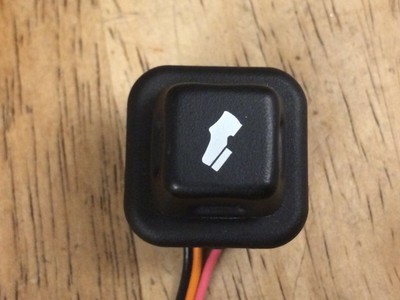
On the left hand side of your steering column, near your tilt steering control, if you have adjustable pedals, you will have a control..

It should look like this if you have power pedals.
2005 Buick Rainier Accelerator Gas / Foot Pedal Slide Control Switch OEM  Part | eBay


Only other way to verify is to look at the actual pedal assembly.

Without power pedals...

With power pedals...
 
For the TB, the sensor is built in so the whole thing would be replaced, if needed.

I would have to disagree with the "tech" at TV. It could be so gummed up that it could stick. In any case, it's good practice to clean it. Just don't forget to disconnect the battery for 30 minutes to reset the PCM's TB parameters.

I can't advise on how to check either of them with a meter but I believe these are usually checked using a scanner (Tech 2 or other high end model) to verify what the pedal is commanding is what the TB is doing and then command the TB via the Tech 2 to different positions and that the TB is responding correctly. That would determine which end is not working correctly.

At the age these trucks are coming to, I would suspect the TB. The gears inside are plastic and get brittle with age. Take it off and give it a shake to hear if there are any loose bits. I haven't seen a lot of pedal sensors go out on this platform.
 
I would.
 
  • Like
Reactions: manoftheearth
I would suggest leaving the battery connected and instead pull the fuses for PCM1 and PCMB for 30 minutes. This will reset the throttle body memory, but avoid the possible issues with the HVAC actuator gears cracking during recalibration, which happens when the battery is disconnected.
 
  • Like
Reactions: manoftheearth
you might consider checking the connectors at the pcm especially the one associated with providing the electrical requirements to the two throttle components in question... looking to see that the pins on the connector and the cable end are "good". Your problem suggests "poor connectivity".

Have you looked at the freeze frame data associated with the codes?

The tech note might also give a place to look for an issue.
 

Attachments

Last edited:
  • Like
Reactions: manoftheearth
you might consider checking the connectors at the pcm especially the one associated with providing the electrical requirements to the two throttle components in question... looking to see that the pins on the connector and the cable end are "good". Your problem suggests "poor connectivity".

Have you looked at the freeze frame data associated with the codes?

The tech note might also give a place to look for an issue.
what is freeze frame data?
 
If I were do replace the acceleration pedal position sensor, do I have to do any calibrating to the PCM? Is it simple plug n' play?

I was told I would need a "oscilloscope-type diagnostic tool".
 
"Freeze Frame" Data are segments of Sensor or Component behavior that have been saved inside a PCM Memory Buffer for later access so that a Technician can Diagnose certain PXXXX Faults.

Installing any OEM GM ACDelco ACC pedal "Right Out of the Box" should work without any problem. However, Safety Issues involving "Engine Control being LOST and causing a RUNAWAY ENGINE and DRIVE-TRAIN" are Topmost in mind for ALL PCM Controls. Thus... follow up Diagnostics are WISE to perform whenever issues of Throttle or Accelerator Pedal problems occur.

Diagnostic Issues may arise where you are trying to determine if there are any "System Glitches" occurring as the ACC Pedal actuates. THIS Excellent Automotive College Instructional Video explains WHY using an Inexpensive Oscilloscope such as a Hantek or PICO-Scope unit are well explained below... with an Instructional Link about Inexpensive Oscilloscopes added in as follows:


And for using the Manual Actuation Positional Foot Pad Testing of the ACC Pedal while measuring the Differences in Voltage Responses between ACC Pin 1 and ACC Pin 2 using a DMM or a DVOM:


NOTE: THIS Second Method will NEVER Be as ACCURATE as using a Digital Oscilloscope Tool to Discover "Glitches" because the DMM or DVOM Sample Rates are NOT Sensitive enough to capture what is actually happening at the Rate of Thousandths of a Second.
 
Last edited:
  • Like
Reactions: budwich
If I were do replace the acceleration pedal position sensor, do I have to do any calibrating to the PCM? Is it simple plug n' play?

I was told I would need a "oscilloscope-type diagnostic tool".
AFAIK, you don't need to calibrate it however it wouldn't be a bad idea to reset the PCM either by disconnecting the battery or pulling the PCM fuses for 30 minutes.
 
  • Like
Reactions: manoftheearth
there are some basic electrical tests for the throttle pedal.... such as impedance / resistance. you can do those while "exercising" it thru its range to see if it response normally / smoothly.
 
  • Like
Reactions: mrrsm
I cleaned the throttle body. Same problem occurs. I ran the codes and get P2135,P2138 and additionally this time I get P1810 and P0113…****
 
I losing patience and am about to just pay the man and replace the pedal and throttle body. Should I look in other places with the PCM or other components before this?
 
The P1810 is a transmission manual valve position issue. Not related to your throttle/accelerator issue.

The P0113 is an out of range voltage on the intake air temperature sensor. That sensor is on the air duct just before it connects to the throttle body. Might have gotten disturbed while you were cleaning the throttle body? If not that consider this.... The wires for that sensor run along with the wires that got chewed by rodents. You may have more damages that you haven't seen yet in that harness.
 
And by no small coincidence... one of the two wires from the PCM to that Intake Air Temp sensor connects to PCM connector C1, pin 13 low reference.

There are 5 low reference pins adjacent to each other on the PCM and there is zero ohms resistance between the lot of them. To my way of thinking that means all these low reference wires are connected together, including the ones connected to your throttle sensors and the accelerator pedal sensors.

Looks like your P0113 is likely related to your P2135 and P2138.
 
Even though you replaced it, try disconnecting the fan clutch and see if the codes will reset and stay away. Sometimes a problem with it can take down the 5V reference for the TB. Might also be for the IAT sensor. Anything but an original ACDelco/Behr/Mahle on these can be unreliable, especially the cheap no-name eBay Chinese clones.
 
And without saying that these actions will be absolutely necessary to perform... This video describes how to deal with the P1810 Code:

 
Even though you replaced it, try disconnecting the fan clutch and see if the codes will reset and stay away. Sometimes a problem with it can take down the 5V reference for the TB. Might also be for the IAT sensor. Anything but an original ACDelco/Behr/Mahle on these can be unreliable, especially the cheap no-name eBay Chinese clones.
I disconnected the fan clutch and I haven’t received the P2135 and P2138 codes or the power drop. I now get a P0526 and the same P0133. The fan clutch I installed was a Duralast from autozone..
 
  • Like
Reactions: budwich

Forum Statistics

Threads
24,240
Posts
648,313
Members
20,673
Latest member
oelarse

Members Online