The "Short Hand" that follows are Screen Prints of Your expansive Post --> Copy-Pasted into the Open Source (Off-Line Privacy Focused) *Thinking-Reasoning* LLM called "Deepseek - R1 - Distill - Qwen - 7B" via Nomic's FREE *GPT4ALL*... Providing a Response which shows that it is
A THINKING - REASONING AI that reveals *What* it is thinking about ...and *How* it arrives at the advice it provides below as the Text added after these images:
First... Your Input...

Next...*IT's* Response...
 What follows shows How and Why this AI arrived at providing *IT's* Suggestions shown above...which is helpful in determining that it is being Truthful and not merely hallucinating *IT's* replies ... with the added advantage that *IT* does NOT Know that WE are READING ITS THOUGHTS:
Response: Okay, so I'm trying to figure out why cylinder #2 in my Silverado is misfiring at idle. Let me go through the information step by step.
First off, there were some previous attempts: swapping plugs and wires didn't help. They replaced AC Delco 41-168 plugs, all the wires (like coil, ignition, etc.), re-flashed the PCM with a new software package from GMAC. So it's not like they changed everything; just these parts.
Compression is good at around 165 psi, which seems fine because that range is usually considered healthy for most engines. The alternator test didn't show any issues either—no leaks or anything wrong there after removing the bad one and checking grounds properly.
The gas smell went away when they fixed something with the fuel lines; so maybe those were causing some issue? But I thought all six seals looked good on the intake manifold, which is supposed to be airtight. Also, no obvious leaks in high-pressure fuel lines while pulling injectors—so that's not it.
Injector circuits: both #2 and #4 tested fine with the right tools (like noid lights), but when they swapped them anyway just for testing purposes, nothing changed because both were misfiring identically at idle. So maybe something is wrong within cylinder #2 itself?
The PCM was re-flashed before getting it so that's probably not where the issue lies since it ruled out software or calibration issues.
When I did a crankshaft relearn after swapping injectors and such, nothing changed—so mechanical stuff in the engine isn't fixed yet. The cam lift on the pushrod side is slightly under spec but they didn't fix it because it wasn't causing any problems? Hmm, maybe that's contributing to the misfire?
I also tried spraying around the intake port with brake cleaner and saw no change—it doesn’t seem like a vacuum issue or something there.
So what else could be wrong in cylinder #2. Since all other cylinders are fine (tested by swapping injectors), it must be specific to cylinder 2's area—maybe the manifold, but they said the six seals looked good when pulled apart? Or maybe the fuel rail?
Wait, did I check the fuel rails for leaks or anything else besides the intake manifold? Maybe there was a small leak in one of them that wasn't noticeable before. But how would that cause misfire at idle specifically on cylinder 2.
Alternatively, could it be something with the injectors themselves—maybe they're not firing correctly even though their resistance and connections are fine?
I also thought about spark plugs: since they re-flashed the PCM after replacing them, maybe there's a problem in how the ignition is being delivered. But if the coil was swapped properly before that step... Hmm.
Wait, another thing—the gas smell went away when they fixed something with fuel lines—maybe the original issue wasn't just bad manifold but also some other related component? Or perhaps after fixing the fuel line issues, it resolved both the misfire and the leak. But in my case, I didn’t have a leak before; so maybe that's not directly causing cylinder #2 to misfire.
I'm starting to think about whether there could be something wrong with the manifold itself beyond just the six seals—maybe some internal gaskets or threads were loose? Or perhaps one of the ports is blocked?
Wait, when I pulled out the intake manifold and looked at the spray holes on the injectors—I did that but didn't see anything obviously wrong. Maybe it's a small blockage in there causing partial misfire.
Another thought: maybe the issue isn't with cylinder #2 itself (since all other cylinders are fine) but something else related to how the engine is being driven—like low oil pressure, or some kind of vacuum leak elsewhere that only affects idle?
Or perhaps it's a problem with the ignition coil for cylinder 2. They swapped injectors and tested them both ways—if they're not firing correctly even though their resistance looks good.
Wait, I also tried swapping #2 and #4 injectors just to eliminate them—so if one was bad but the other wasn't (but since both were misfiring), maybe it's something else. Maybe the manifold is leaking on cylinder 2 side?
I remember that sometimes when you relearn the engine or do certain things, the fuel rail pressure can change which might affect how injectors are firing.
Wait—could there be a problem with the vacuum pump? If so, pulling too much vacuum could cause misfire. But I don't think they tested for that specifically on cylinder 2—it's more of an overall issue if it was related to the manifold or something else specific.
Another angle: maybe the timing chain is off—but since cam lift wasn’t adjusted and didn't seem problematic (within spec), probably not that unless there’s a resonance causing misfire at idle. But I don't know enough about that area yet.
I also thought of checking for vacuum leaks in all areas, but with the engine running now without issues under load—maybe it's something else like an ECT or O2 sensor? They didn’t test those before swapping injectors though.
Wait a second—if they re-flashed the PCM after replacing plugs and wires—it’s possible that some of the misfire is due to incorrect timing signals. But since all other cylinders are fine, maybe cylinder 2's firing order isn't matching what the PCM expects? Or perhaps there was an issue with how the PCM communicated through the ECU.
But then why would swapping injectors not fix it if the problem were in the communication between injector and PCM?
Alternatively—could this be a case of “cylinder specific” misfire due to something like manifold leakage on that cylinder's side? Or maybe the fuel rail for that cylinder is clogged or has some issue.
Wait, when I pulled out the intake manifold—I should have checked all ports. Maybe one port was slightly blocked in such a way that it doesn't let enough air into each injector—so causing partial misfire at idle but not under load because more power would compensate?
But how to test for that without pulling apart? Maybe using a vacuum pump on the manifold or something.
Another thought: maybe there's an issue with the fuel pressure regulator—if cylinder 2 is getting too much or too little, it could cause issues. But I don't think they tested the fuel lines specifically around that area either.
Wait—could this be related to the engine oil? If low oil level causes misfire at idle but not under load because more power doesn’t affect it as much—but how would I know?
I'm also considering whether there's a problem with the manifold itself beyond just the six air intake ports. Maybe one of the manifold gaskets is loose, causing some kind of partial vacuum or flow restriction on cylinder 2.
Alternatively—could this be something like an EGR valve issue? If it was closed too much at idle but open enough under load—it could cause misfire—but I don't think they mentioned that before. Plus, after fixing the fuel lines and such...
Wait—if you relearned the engine when swapping injectors—I did a relearn on the camshaft as well—maybe there's something else in the timing or alignment causing it.
I'm getting stuck here because all other cylinders are fine but cylinder 2 isn't. So maybe I need to look at more specific areas within that cylinder—but without access, how?
Wait—if they had a leak before when pulling injectors and fixing fuel lines—maybe after those fixes, the issue resolved in cylinder #2? But since no leaks were found on intake manifold or high-pressure lines...
I'm starting to think maybe it's something with the manifold itself beyond just the six air ports. Maybe one of its other connections is causing a partial vacuum that only affects idle.
Alternatively—could there be an issue where the manifold was improperly calibrated, leading to misfire at certain speeds?
Wait—if I had a bad manifold before—the symptoms would include leaks when pulling injectors or fuel lines—but since they fixed those and it's not leaking now... Maybe something else is wrong with cylinder 2 itself.
Another thought: maybe there’s an issue in the way the manifold connects to the engine block—like some threads are loose, causing partial vacuum on that side. But again, without pulling apart...
Wait—I also tried spraying around the fuel rail—but if it's a small leak or something else related only to cylinder 2.
Alternatively—if I had a problem with the ECT sensor—it would cause misfire across all cylinders when cold but not necessarily at idle unless other factors are involved. But they didn't test that before swapping injectors so maybe...
Wait, another idea: could it be an issue where one of the manifold's intake ports is blocked by something like debris or a small part? That might only happen during certain conditions—like at idle when speed is low and engine cooling isn’t as effective.
But how would I test for that without pulling apart?
I'm also considering whether there’s any chance it could be related to the fuel pump. If cylinder 2's injectors are getting too much or not enough fuel, but they tested the lines so maybe...
Wait—I remember when you relearn an engine—it can sometimes adjust things like air/fuel ratios based on how other cylinders behave—so if only one is misfiring at idle and others aren't affected by it under load—but I don’t know for sure.
Another angle: could this be a case of “cylinder specific” manifold issues? Like, maybe the manifold was designed differently or had some wear that's not visible from outside but affects firing on cylinder 2 specifically. But without more info...
Wait—I also thought about checking the fuel rails themselves—maybe one is blocked somewhere causing partial misfire.
But I didn't test for leaks in all of them before swapping injectors, so maybe there was a small leak or something that only affected when pulling specific injectors?
I'm starting to think it's time to look into cylinder 2 itself more carefully. Maybe the manifold has some issues beyond what’s visible—like gasket problems on certain sides.
Alternatively—if I had an issue with the fuel rail for cylinder #2, maybe there was a small crack or something that only affects when pulling injectors because of how it's connected to other parts?
I'm not sure—I think at this point without more tools and access, it might be difficult. Maybe suggesting replacing the manifold if possible? Or checking all connections thoroughly.
Wait—could I test for manifold vacuum leaks using a vacuum pump on each side? If so, maybe that would help identify where the leak is—if any—but since they fixed other parts...
Alternatively—I could try to see if there's an issue with the manifold’s connection points or threads. Maybe those are loose and causing partial vacuums.
I'm also considering whether it might be a problem related to the engine block itself—like some misalignment that affects only cylinder 2 at idle—but again, without access...
Wait—I think I remember something about manifold port connections—if one of them is slightly worn or not properly seated, it could cause partial vacuum. Maybe using a feeler gauge on each connection point?
But since they had fixed the other parts already... Hmm.
I'm starting to realize that this might require more detailed inspection than possible without specialized tools and access—so maybe suggesting replacing cylinder 2's manifold if there are any signs of wear or misalignment beyond what was noticed before fixing previous issues.The issue with cylinder #2 causing misfire at idle but not under load likely stems from a specific problem within the engine's manifold. Here is a structured approach to diagnose and address it:
1. **Reinspect the Manifold:**
- Check for any signs of wear or misalignment on the intake ports, especially focusing on those connected to cylinder #2.
- Use feeler gauges to ensure all connections are properly seated without gaps.
2. **Check Connection Points:**
- Inspect each manifold port connection point (e.g., bolts and nuts) for tightness. Loose or worn-out connections could cause partial vacuum issues affecting only certain cylinders at specific engine speeds.
3. **Test Vacuum on Each Side:**
- Use a vacuum pump to test the intake side of cylinder #2's manifold separately from other cylinders. A persistent low-pressure reading might indicate an issue with that particular port.
4. **Evaluate Gasket Health:**
- Ensure all gaskets around the manifold and engine block connections are intact, as degraded or worn-out gaskets can lead to partial vacuum leaks.
5. **Consider Replacing the Manifold:**
- If multiple signs of wear or misalignment are present beyond what was previously addressed (like fixing fuel lines), replacing the entire manifold might be necessary for optimal performance across all cylinders.
6. **Consult a Professional:**
- Given the complexity and potential risks involved, consulting with an automotive professional is recommended to ensure proper diagnosis and execution of any necessary repairs.
By systematically addressing each connection point and inspecting the manifold's integrity, you can identify whether cylinder #2 has specific issues contributing to its misfire at idle.




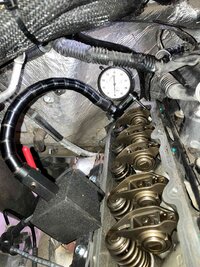
 , I finally managed to bolt a piece of strap iron to the head to mount one of my magnetic base dial indicators. Unfortunately the eyecrometer is not accurate enough for this. The #6 intake valve lift was .245" and the exhaust valve lift was .220". So I'm afraid what we're looking at is a failing lifter on the #6 exhaust valve causing the chirping noise.