2018 Silverado 4.3L. Hard miss at idle, disappears under load.

clevdan

Member
Joined
May 31, 2022
Posts
9
Location
Katy, TX
Hello all. 2018 Silverado with a 4.3 L, 100,700 miles belonging to a friend of a friend so I’m getting all my information second hand. About two months ago cylinder #2 started misfiring at idle. Two other people have worked on it before me. Plugs (AC Delco 41-168), wires and injectors have been replaced. The PCM has been re-flashed. Sounds like they were loading and firing the parts cannon.

I swapped the #2 and #4 plugs, then the #2 and #4 wires, then the #2 and #4 coils. #2 still has continuous misfire at idle. Tested #2 with spark tester, flashes while cranking and running. Checked compression and got 165 psi over several tests. A Google inquiry says 155-165 psi is the healthy range. Bought a leak down tester and shows little to no leakage at TDC. I disconnected the alternator field and battery wires because bad alternator grounds can knock out one (not all, just one) injector driver in a Detroit Diesel ECM. No change.

Had heavy gas smell in the engine compartment. Removed intake manifold, all six seals looked good. Cleaned throttle body while intake was removed. Didn’t see any obvious leaks at the high-pressure fuel lines. Pulled the passenger side injector rail to get a look at the injector spray holes. Spray holes looked good. All injector connectors were plugged in and the injectors are obviously new. #2 and #4 injector coils measure 1.5 Ω. Jumpered #2 injector connector with jumper wire kit (terminals have good pin drag) and checked circuit resistance at PCM terminals 51 and 71. #2 injector circuit measures 1.2 Ω. Tested #2 and #4 injector circuits with noid lights and both circuits flash the lights while cranking. Swapped #2 and #4 injectors anyway just to eliminate the injectors. I have preformed a crankshaft relearn which made no difference.

Removed passenger side valve cover and checked cam lift on the pushrod side of the rocker arm. The intake has .235” and the exhaust has .232” of travel. The spec is .274”-.278”. Since these are hydraulic lifters being .040” shy didn’t bother me and I can see the needle on my dial indicator going down as the lifter loses some oil. I couldn’t get my dial indicator on any of the other rocker arms because the heater and a/c lines are in the way.

Put it all back together and #2 still has a consistent miss at idle. Put it in gear and with a little throttle to give it some load the misfire disappears. While driving the misfire disappears until you go to no-throttle to come to a stop. The one thing that changed is the heavy gas smell is gone now, probably from having the high-pressure fuel lines properly torqued.

I’ve got good compression. My injector circuit tests good. My coil circuit tests good. I’ve got spark. I sprayed around the #2 intake port as good as I could with brake parts cleaner with no change in engine sound or rpm. Got a smoke machine to check for vacuum leaks but didn’t see any smoke escaping the manifold or seals. Have tried different intake manifold with new seals, no change. Even though they looked clean and tight, I disconnected G110 (the PCM ground to the block) and G140 (the passenger side coil harness to the head), shined them with sand paper (they had no rust or corrosion) and reconnected. The only part that has not been swapped with another cylinder or tested good is the PCM. The PCM was re-flashed with latest calibration/software prior to me getting the truck which would seem to rule out calibration or software issues. If it is a mechanical issue in the PCM, why does the miss disappear under load?

What am I missing here? Except cylinder #2 of course, which is the whole reason for the post.
 
Sounds like the PCM signal to the #2 injector could be suspect. Do you have access to a scope to compare the injector signals between #2 (bad) and the others (good)?
 
  • Like
  • Love
Reactions: Mooseman and mrrsm
The "Short Hand" that follows are Screen Prints of Your expansive Post --> Copy-Pasted into the Open Source (Off-Line Privacy Focused) *Thinking-Reasoning* LLM called "Deepseek - R1 - Distill - Qwen - 7B" via Nomic's FREE *GPT4ALL*... Providing a Response which shows that it is A THINKING - REASONING AI that reveals *What* it is thinking about ...and *How* it arrives at the advice it provides below as the Text added after these images:

First... Your Input...

POSTPROMPT.jpg

Next...*IT's* Response...

POSTRESPONSE.jpg

What follows shows How and Why this AI arrived at providing *IT's* Suggestions shown above...which is helpful in determining that it is being Truthful and not merely hallucinating *IT's* replies ... with the added advantage that *IT* does NOT Know that WE are READING ITS THOUGHTS:

Response: Okay, so I'm trying to figure out why cylinder #2 in my Silverado is misfiring at idle. Let me go through the information step by step.

First off, there were some previous attempts: swapping plugs and wires didn't help. They replaced AC Delco 41-168 plugs, all the wires (like coil, ignition, etc.), re-flashed the PCM with a new software package from GMAC. So it's not like they changed everything; just these parts.

Compression is good at around 165 psi, which seems fine because that range is usually considered healthy for most engines. The alternator test didn't show any issues either—no leaks or anything wrong there after removing the bad one and checking grounds properly.

The gas smell went away when they fixed something with the fuel lines; so maybe those were causing some issue? But I thought all six seals looked good on the intake manifold, which is supposed to be airtight. Also, no obvious leaks in high-pressure fuel lines while pulling injectors—so that's not it.

Injector circuits: both #2 and #4 tested fine with the right tools (like noid lights), but when they swapped them anyway just for testing purposes, nothing changed because both were misfiring identically at idle. So maybe something is wrong within cylinder #2 itself?

The PCM was re-flashed before getting it so that's probably not where the issue lies since it ruled out software or calibration issues.

When I did a crankshaft relearn after swapping injectors and such, nothing changed—so mechanical stuff in the engine isn't fixed yet. The cam lift on the pushrod side is slightly under spec but they didn't fix it because it wasn't causing any problems? Hmm, maybe that's contributing to the misfire?

I also tried spraying around the intake port with brake cleaner and saw no change—it doesn’t seem like a vacuum issue or something there.

So what else could be wrong in cylinder #2. Since all other cylinders are fine (tested by swapping injectors), it must be specific to cylinder 2's area—maybe the manifold, but they said the six seals looked good when pulled apart? Or maybe the fuel rail?

Wait, did I check the fuel rails for leaks or anything else besides the intake manifold? Maybe there was a small leak in one of them that wasn't noticeable before. But how would that cause misfire at idle specifically on cylinder 2.

Alternatively, could it be something with the injectors themselves—maybe they're not firing correctly even though their resistance and connections are fine?

I also thought about spark plugs: since they re-flashed the PCM after replacing them, maybe there's a problem in how the ignition is being delivered. But if the coil was swapped properly before that step... Hmm.

Wait, another thing—the gas smell went away when they fixed something with fuel lines—maybe the original issue wasn't just bad manifold but also some other related component? Or perhaps after fixing the fuel line issues, it resolved both the misfire and the leak. But in my case, I didn’t have a leak before; so maybe that's not directly causing cylinder #2 to misfire.

I'm starting to think about whether there could be something wrong with the manifold itself beyond just the six seals—maybe some internal gaskets or threads were loose? Or perhaps one of the ports is blocked?

Wait, when I pulled out the intake manifold and looked at the spray holes on the injectors—I did that but didn't see anything obviously wrong. Maybe it's a small blockage in there causing partial misfire.

Another thought: maybe the issue isn't with cylinder #2 itself (since all other cylinders are fine) but something else related to how the engine is being driven—like low oil pressure, or some kind of vacuum leak elsewhere that only affects idle?

Or perhaps it's a problem with the ignition coil for cylinder 2. They swapped injectors and tested them both ways—if they're not firing correctly even though their resistance looks good.

Wait, I also tried swapping #2 and #4 injectors just to eliminate them—so if one was bad but the other wasn't (but since both were misfiring), maybe it's something else. Maybe the manifold is leaking on cylinder 2 side?

I remember that sometimes when you relearn the engine or do certain things, the fuel rail pressure can change which might affect how injectors are firing.

Wait—could there be a problem with the vacuum pump? If so, pulling too much vacuum could cause misfire. But I don't think they tested for that specifically on cylinder 2—it's more of an overall issue if it was related to the manifold or something else specific.

Another angle: maybe the timing chain is off—but since cam lift wasn’t adjusted and didn't seem problematic (within spec), probably not that unless there’s a resonance causing misfire at idle. But I don't know enough about that area yet.

I also thought of checking for vacuum leaks in all areas, but with the engine running now without issues under load—maybe it's something else like an ECT or O2 sensor? They didn’t test those before swapping injectors though.

Wait a second—if they re-flashed the PCM after replacing plugs and wires—it’s possible that some of the misfire is due to incorrect timing signals. But since all other cylinders are fine, maybe cylinder 2's firing order isn't matching what the PCM expects? Or perhaps there was an issue with how the PCM communicated through the ECU.

But then why would swapping injectors not fix it if the problem were in the communication between injector and PCM?

Alternatively—could this be a case of “cylinder specific” misfire due to something like manifold leakage on that cylinder's side? Or maybe the fuel rail for that cylinder is clogged or has some issue.

Wait, when I pulled out the intake manifold—I should have checked all ports. Maybe one port was slightly blocked in such a way that it doesn't let enough air into each injector—so causing partial misfire at idle but not under load because more power would compensate?

But how to test for that without pulling apart? Maybe using a vacuum pump on the manifold or something.

Another thought: maybe there's an issue with the fuel pressure regulator—if cylinder 2 is getting too much or too little, it could cause issues. But I don't think they tested the fuel lines specifically around that area either.

Wait—could this be related to the engine oil? If low oil level causes misfire at idle but not under load because more power doesn’t affect it as much—but how would I know?

I'm also considering whether there's a problem with the manifold itself beyond just the six air intake ports. Maybe one of the manifold gaskets is loose, causing some kind of partial vacuum or flow restriction on cylinder 2.

Alternatively—could this be something like an EGR valve issue? If it was closed too much at idle but open enough under load—it could cause misfire—but I don't think they mentioned that before. Plus, after fixing the fuel lines and such...

Wait—if you relearned the engine when swapping injectors—I did a relearn on the camshaft as well—maybe there's something else in the timing or alignment causing it.

I'm getting stuck here because all other cylinders are fine but cylinder 2 isn't. So maybe I need to look at more specific areas within that cylinder—but without access, how?

Wait—if they had a leak before when pulling injectors and fixing fuel lines—maybe after those fixes, the issue resolved in cylinder #2? But since no leaks were found on intake manifold or high-pressure lines...

I'm starting to think maybe it's something with the manifold itself beyond just the six air ports. Maybe one of its other connections is causing a partial vacuum that only affects idle.

Alternatively—could there be an issue where the manifold was improperly calibrated, leading to misfire at certain speeds?

Wait—if I had a bad manifold before—the symptoms would include leaks when pulling injectors or fuel lines—but since they fixed those and it's not leaking now... Maybe something else is wrong with cylinder 2 itself.

Another thought: maybe there’s an issue in the way the manifold connects to the engine block—like some threads are loose, causing partial vacuum on that side. But again, without pulling apart...

Wait—I also tried spraying around the fuel rail—but if it's a small leak or something else related only to cylinder 2.

Alternatively—if I had a problem with the ECT sensor—it would cause misfire across all cylinders when cold but not necessarily at idle unless other factors are involved. But they didn't test that before swapping injectors so maybe...

Wait, another idea: could it be an issue where one of the manifold's intake ports is blocked by something like debris or a small part? That might only happen during certain conditions—like at idle when speed is low and engine cooling isn’t as effective.

But how would I test for that without pulling apart?

I'm also considering whether there’s any chance it could be related to the fuel pump. If cylinder 2's injectors are getting too much or not enough fuel, but they tested the lines so maybe...

Wait—I remember when you relearn an engine—it can sometimes adjust things like air/fuel ratios based on how other cylinders behave—so if only one is misfiring at idle and others aren't affected by it under load—but I don’t know for sure.

Another angle: could this be a case of “cylinder specific” manifold issues? Like, maybe the manifold was designed differently or had some wear that's not visible from outside but affects firing on cylinder 2 specifically. But without more info...

Wait—I also thought about checking the fuel rails themselves—maybe one is blocked somewhere causing partial misfire.

But I didn't test for leaks in all of them before swapping injectors, so maybe there was a small leak or something that only affected when pulling specific injectors?

I'm starting to think it's time to look into cylinder 2 itself more carefully. Maybe the manifold has some issues beyond what’s visible—like gasket problems on certain sides.

Alternatively—if I had an issue with the fuel rail for cylinder #2, maybe there was a small crack or something that only affects when pulling injectors because of how it's connected to other parts?

I'm not sure—I think at this point without more tools and access, it might be difficult. Maybe suggesting replacing the manifold if possible? Or checking all connections thoroughly.

Wait—could I test for manifold vacuum leaks using a vacuum pump on each side? If so, maybe that would help identify where the leak is—if any—but since they fixed other parts...

Alternatively—I could try to see if there's an issue with the manifold’s connection points or threads. Maybe those are loose and causing partial vacuums.

I'm also considering whether it might be a problem related to the engine block itself—like some misalignment that affects only cylinder 2 at idle—but again, without access...

Wait—I think I remember something about manifold port connections—if one of them is slightly worn or not properly seated, it could cause partial vacuum. Maybe using a feeler gauge on each connection point?

But since they had fixed the other parts already... Hmm.

I'm starting to realize that this might require more detailed inspection than possible without specialized tools and access—so maybe suggesting replacing cylinder 2's manifold if there are any signs of wear or misalignment beyond what was noticed before fixing previous issues.The issue with cylinder #2 causing misfire at idle but not under load likely stems from a specific problem within the engine's manifold. Here is a structured approach to diagnose and address it:

1. **Reinspect the Manifold:**

- Check for any signs of wear or misalignment on the intake ports, especially focusing on those connected to cylinder #2.

- Use feeler gauges to ensure all connections are properly seated without gaps.

2. **Check Connection Points:**

- Inspect each manifold port connection point (e.g., bolts and nuts) for tightness. Loose or worn-out connections could cause partial vacuum issues affecting only certain cylinders at specific engine speeds.

3. **Test Vacuum on Each Side:**

- Use a vacuum pump to test the intake side of cylinder #2's manifold separately from other cylinders. A persistent low-pressure reading might indicate an issue with that particular port.

4. **Evaluate Gasket Health:**

- Ensure all gaskets around the manifold and engine block connections are intact, as degraded or worn-out gaskets can lead to partial vacuum leaks.

5. **Consider Replacing the Manifold:**

- If multiple signs of wear or misalignment are present beyond what was previously addressed (like fixing fuel lines), replacing the entire manifold might be necessary for optimal performance across all cylinders.

6. **Consult a Professional:**

- Given the complexity and potential risks involved, consulting with an automotive professional is recommended to ensure proper diagnosis and execution of any necessary repairs.

By systematically addressing each connection point and inspecting the manifold's integrity, you can identify whether cylinder #2 has specific issues contributing to its misfire at idle.
 
Last edited:
Check ALL of your Engine Block to Firewall and Body Grounds (Failing, Badly Corroded Braided Copper Mesh Bonding Cables and their Mounts for GREEN Corrosion) as increased Resistance to Current on the Ground Side of the Electrical Circuits that Ground to the Block can become a real problem for Coils and EFIs that suffer any Voltage Drops.

Following on with @azswiss' suggestion to "Use a Scope"...here are some "Known Good Primary and Secondary Coil Over Plug" Wave Forms and some information on How to READ what you see on the "O" Scope Screen:

COPSPARKAUTOPSY1.jpg
PRIMARYCOPEXPLAINED.jpg
SECONDARYIGNITIONWAVEFORM.jpg
SECONDARYCOILCIRCUITPARADE.jpg

It is always helpful to use an Inexpensive Oscilloscope and a COP WAND to quickly Read and Compare what the Primary and Secondary Wave Forms look like on adjacent cylinders to get an idea of what a KNOWN GOOD COP Wave Form looks like on your particular Engine.

158258-11ed1dc0311da8d29c5b8ad23fddeb58.jpg


And here is what a Known Good (BLUE TRACE) versus Known BAD (RED TRACE) EFI Wave Forms Looks like. Notice the *Dimple* in the descending BLUE TRACE...? THAT is the point at which the Activated Pintle Valve of a GOOD WORKING EFI... Closes... THAT Artifact is MISSING from the RED TRACE!:

1771784051761.png

It follows on that a Visit to THIS Link covers ALL Aspects of Automotive Oscilloscopes and Support Equipment needed to do the job with MANY Examples of HOW To DO the Jobs and find out exactly what you need to know on this topic:

 
Last edited:
Sounds similar to my slight miss at idle issue except yours is a constant miss at idle.

One thing I haven't seen in your post is the crank and cam sensors. Were those replaced? even if not, I would attempt a CASE or CKP angle relearn. Can't hurt and would be necessary if the CKP sensor is/was replaced.

I would also do a compression test on all the cylinders to compare each. The missing cylinder in mine was slightly lower than the others and may be responsible for the intermittent miss at idle. I was also the victim of fake ACDelco plugs. I haven't checked my misfires lately but it's been idled a lot during winter warmups and no CEL.
 
  • Like
Reactions: mrrsm
And if you don't want to have to "Get Dirty" right off the bat by pulling the Spark Plugs one after the other for a Hands-On Pressure Gauge use... You can use an Oscilloscope to perform a "Relative Compression Test" by using your Laptop, a PICO-Scope Model #2204A and a High Amp Clamp encircling either the Ground Cable or the B+ Red Cable leading to the Starter Motor in the following manner to get a "Parade View" of the Amperage Draw during a Ten Second Engine Turn Over:

RELATIVECOMPRESSION.jpg

This allows you to visually compare the "Counter-Electro-Motive Force" that each Cylinder renders as the Pistons approach TDC and makes the Starter Motor either work Harder on Higher Compression Cylinders, or produce Lower Compression on Cylinders with leaking valves or bad rings:


Last edited:
Sounds like the PCM signal to the #2 injector could be suspect. Do you have access to a scope to compare the injector signals between #2 (bad) and the others (good)?
Thanks for the replies, guys. No, I don't have a scope. It looks to me like I will have to spend about $300.00 in the jungle to get a PICO-Scope Model #2204A, Hantek current clamp, auto test leads and a 20:1 attenuator. That's a lot of money to spend on tools for a vehicle that doesn't belong to me.

I'm a semi-retired diesel field service mechanic that works mainly on 60 Series Detroit Diesels and Allison automatic transmissions in workover rigs and other oil field equipment. I try my best NOT to work on automobiles. I normally only work on MY automobiles, and then only when they make me. I'm looking at this truck for a friend from church and the truck belongs to a friend of his.

Mooseman; No, the CKP and CMP sensors have not been disturbed. I know my original post was a novel but the last line in the 3rd paragraph says I did a CKP relearn and it made no difference. I'm thinking that the compression and leak down tests (which I had to buy tools for) eliminated mechanical problems in cyl #2. I don't know where the spark plugs were sourced from but I assume (yes, I know all about that word) a parts store like O'Reilly's or VatoZone.

mrmsm: It seems like the AI is stuck on the intake manifold at a stop sign. I checked the intake with a smoke machine (which I had to buy tools for) and the intake manifold I tried in paragraph 6 was a brand new, in-the-box GM part with new seals. When that made no difference, I re-installed the original manifold with the new seals. Every time the intake has been installed (I think it's been off 6 or 8 times) the bolts were torqued to 45 lb/in. and 90 lb/in. in the correct sequence and two-step process. I'm a firm believer in torque wrenches and use all of mine religiously. I'm thinking a new intake manifold eliminated the original manifold as the problem.

The injectors are direct injection in the head, not port injection. This means you have to remove the intake to even see them or their connectors. This truck does not fit in my garage so I'm working in the driveway. My oak tree is steadily dropping leaves into the engine compartment while I work so I don't want to run the engine with the intake removed. But you have to remove the intake to have access to the injectors and their connectors. And I doubt there would be room for scope test leads with the intake installed.

Let me explain my thought process. If I swap a part to a different cylinder and the miss does not follow the part, that tells me that part was not the cause of the miss. Therefore; when I swapped spark plugs, plug wires, coils and injectors between cyl #2 and cyl #4 and the miss stayed on cyl #2, those parts have been eliminated as the source of the problem. I tried a NEW manifold with new seals and the miss stayed on cyl #2, that eliminates the intake manifold. The coil and injector wires test good, not open or shorted and the injector wires light noid lights. The compression and leak down tests eliminate the cylinder. My grounds are good, clean and tight. The only part I have not swapped is the PCM and the salvage yards in Houston with searchable inventory don't have any 2018 Silverados with the 4.3L.
 
  • Like
Reactions: movietvet
Let me explain my thought process. If I swap a part to a different cylinder and the miss does not follow the part, that tells me that part was not the cause of the miss. Therefore; when I swapped spark plugs, plug wires, coils and injectors between cyl #2 and cyl #4 and the miss stayed on cyl #2, those parts have been eliminated as the source of the problem. I tried a NEW manifold with new seals and the miss stayed on cyl #2, that eliminates the intake manifold. The coil and injector wires test good, not open or shorted and the injector wires light noid lights. The compression and leak down tests eliminate the cylinder. My grounds are good, clean and tight. The only part I have not swapped is the PCM and the salvage yards in Houston with searchable inventory don't have any 2018 Silverados with the 4.3L.
That's called swapnostics and you're correct. All the parts you swapped from one cylinder to another says the problem is staying with the bad cylinder. So it would be something static to that cylinder like a mechanical issue (which you disproved with compression and leakdown tests), wiring, a leak of some sort at that cylinder only (gas or vacuum). Can you wire in the noid light to the coil and the injector? If not at the coil/injector but at the ECM? Not just for cranking but running. This way you could see if the light flashes irregular or out at idle. If it doesn't then you'll need to try at the coil/injector end.

Here's a thought. Is this an AFM/DFM engine? If so, what if one of the lifters for that cylinder is defective and leaking oil pressure at a high enough rate that at idle it has more time to bleed down oil pressure but at speed it's able to open the valve?
 
Any SIs or TSBs around covering issues with the 4.3L Ecotec GDI Fuel Injectors? This video gives all of us a chance to sort of "be in your shoes" and gives us a better idea of what you had to deal with while working on the Engine Top End components R&R:


Attachments

Last edited:
  • Like
Reactions: movietvet
mrrsm; Thank you for the video and the 4.3L V6 pdf. That lets others see the procedure for getting to the injectors and why scoping the injectors won't be the easiest thing to do. And as stated in post #7 above; the truck does not fit in my garage so I'm working in the driveway. My oak tree is steadily dropping leaves into the engine compartment while I work so I don't want to run the engine with the intake removed.

AllData DIY does list a TSB concerning noise and misfires, attached below.

19-NA-219 mentions noise but I don’t have any noise, just a misfire. It also mentions on page 3, regarding checking cam lobe lift which I mentioned in post #1, paragraph 4; The lift in this location will differ from the SI specification but it should be similar as compared with other rockers on the same bank. I was about 0.040” shy of the spec on cyl #2 but was watching the indicator needle drop when having to stop turning to reset the ratchet. I couldn’t manage to get on the other cylinders with the setup I was using and no matter how I try I couldn’t get any of my magnetic dial indicator bases to stick to that d$&*ed aluminum head. I may need to give a little more thought to figure out how to redneck a solution to that issue.

I highlighted a section on page 5 about valve leakage and have attached a picture of one of 5 leak down tests which all gave the same result.

Mooseman; Never heard the term swapnostics, I'll have to keep that in the memory banks for later usage. I was, however, taught to always check the cheap, easy stuff first. And swapping parts is a cheap and easy way to eliminate possible sources of the problem.

I have tried the noid lights (post #1, paragraph 3) while cranking on both the #2 and #4 injector connectors with the intake off so the connectors were accessible. The lights flashed on both connectors while cranking. I see no way to connect the noid lights at the ECM as I would have to dig into a very tightly loomed harness and don't want to cause any more problems while looking for this one. The noid light kit I borrowed from O'Reilly's didn't have a light that would plug into the 4-wire coil connector so I tried with jumper wires but was unsuccessful. I did test spark with my old 90° spark plug tester which forced me to hold the spark plug grounded to the engine block. THAT lit me up! So, I bought a straight spark plug tester that I could use with the spark plug in the head and got good spark, both cranking and running. To me that clears the coil as the source of the problem.

Yes, this is an AFM engine, it is not DFM. Cyls 3 and 6 are the AFM cylinders. The owner does have an AFM/DFM delete dongle to plug into the obd2 connector. While speaking to him the other day he mentioned the problem started after he plugged it in while driving to see if he could tell any difference between 4 cylinders and 6. So I've been thinking he may have spiked the ECM when he did that. This would go back to azswiss’s post #2 above.

This is the first time I’ve used AllData DIY and for $20.00 I’m pretty happy with all the information you can find. Notice what I’ve highlighted on page 5 of the attached Fuel System Description.

I have found a website, Flagship One, https://www.fs1inc.com/ that lists reman ECMs programmed to your VIN for, in this case, $228.00 with free shipping and lifetime warranty. Has anyone ever heard of or used these folks? They're in Lynbrook, NY. If not, who do you use for replacement ECMs? I'm not quite ready to go that route but I'm getting close.
 

Attachments

  • Like
Reactions: movietvet
I usually grab a used one from the Pick-n-Pull and program it myself but I have the tools to do this, especially on older iron. For your 2018, you would need a J2534 type tool like this one and an ACDelco TDS subscription ($40USD for 1 VIN).

Either way, you would also need to do a CASE (Crankshaft Angle Sensor Error) relearn so a capable bi-directional scanner would be required.

It would be kinda weird for the ECM to have an intermittent failure like this. It's too bad you can't use a noid light to prove it. There are ways to get to the connectors without pulling them by using T-pins inserted in the back of the connector into the wires you want to probe or use wire piercers.
 
  • Like
Reactions: movietvet
I'm with you 100% on NOT investing in the Oscilloscope Equipment for such an isolated case... but for anyone needing to identify their GDI EFI Performance not wanting to disassemble the Top End to gain access to these unique Injectors...there IS an alternative method that will reveal what a KNOWN GOOD GDI Injector Wave Form should look like as per this image:

KNOWNGOODGDIVOLTAGEANDCURRENTWAVEFORM.jpg

...and this is the means to access them is via the GDI Harness via back-probing at each external harness connector as per THIS Instructional Video:

Diagnosing a GDI EFI using a Very Inexpensive Oscilloscope:


You mention some very interesting issues concerning Oil Pressure and Ignition vs, Cam Timing that are covered HERE:

Understanding How GDI Fuel Injection Works:

 
And in a true WTF moment......... I bought the Pico 2204A scope along with 2 sets of automotive test leads with 20:1 attenuators and a current clamp. They got here this morning so I called the customer to have him bring the truck over. He told me he had the oil changed Wednesday and has been driving it for two days. He said the CEL and traction control lights went out and it's been running better. I connected my autel MK808 a few minutes ago and there are NO, nada, none, zilch, zero misfires whereas before they would start counting on cyl #2 immediately once you started the engine. I am, however, now hearing a chirping noise coming from the right valve cover area towards the rear (#6). I do not recall hearing this chirping ANY of the other times I've had this engine running with the miss.

19-NA-219 attached in post #10 does talk about chirping noises possibly being caused by faults with AFM lifters. But again, this is the first time I've heard this noise in all the times I've had the engine running before (refer to paragraph 3, line 1 in post #10). And my miss has always been on cyl #2, not #6. I'm going to pull the valve cover and see if I can redneck a way to get my dial indicator on the #6 rockers and check cam lobe lift.
 
  • Wow
  • Love
Reactions: mrrsm and Mooseman
So after muttering several words I'm glad the grandkids weren't around to hear 🤬, I finally managed to bolt a piece of strap iron to the head to mount one of my magnetic base dial indicators. Unfortunately the eyecrometer is not accurate enough for this. The #6 intake valve lift was .245" and the exhaust valve lift was .220". So I'm afraid what we're looking at is a failing lifter on the #6 exhaust valve causing the chirping noise.
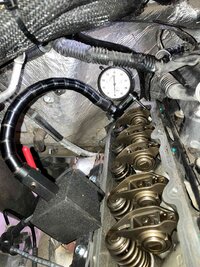
I'm still not sure what was causing the dead miss on the #2 cyl . I have video of this (a .mov and a .mpg) but it won't let me attach either one to the post. I absolutely HATE it when I fix something (or in this case it heals itself) and don't know how I fixed it. Every mechanic I've ever known has had these (and I've worked in several shops in my 48 years as a mechanic) and NONE of them like it!

So since I also don't like forum threads that have no resolution the way this one ends is as follows; An oil change healed a dead miss. Maybe it flushed a piece of debris from an oil galley that was keeping a lifter from fully pumping up??? And when the miss disappeared on one cylinder, a chirping noise appeared on another, indicating a failing AFM lifter. The customer has decided at this point to trade the truck off and get another vehicle.
 

Attachments

  • IMG_8008 a.jpg
    IMG_8008 a.jpg
    806 KB · Views: 7
Last edited:
  • Like
Reactions: Mooseman and mrrsm
Damn... Unless you sprayed down the interior of the Valve Train and Head with a Spray Solvent... those area of the Roller Rockers, Valve Stems, Springs and Keepers ...look *Squeaky* Clean & BONE DRY.... suggesting that the Oil Flow and the Oil Pressure to the Head may be compromised... and might invite the *Squeaking* Noises to come from the Tips Rocker Ends at the Valve Stems and where the Push-Rod Ball Ends meet inside of Bone Dry Cups.

Congratulations on making the choice of getting the PICO-Scope Gear. Try to visit the PICO-Scope Site and Download their prior 6.5 Version of the FREE Auto Diagnostic Software for the Windows OS... as it has features that can be a bit EZR to set up and use with the 'Scope than the later Version 7.


...and MUCH More assistance is available in THIS dedicated Oscilloscope "How-Tos" and Practical Example:

 
Last edited:
No, I didn't clean anything under the valve cover. There was oil on all of the rockers, both at the pushrod and valve stem ends. You have to zoom in on the picture to see it very well.

My PicoScope software version is 7.2.10.7893. I don't see a way to download 6.5. I used their search feature and didn't have any luck. Most of the YouTube PicoScope videos I see are showing guys with earlier software which doesn't look like the screen mine gives me. So it will be a learning curve to use the scope but what else is new?

I'm just glad this truck is gone, I do not like vehicles I can't fix! This experience just reinforces my reluctance to buy any newer vehicles than I already have. My current stable includes my lowest mileage vehicle, a '02 Saturn SL2 with 467,000 miles (overhauled at 406,000 to get rid of oil consumption), my '92 GMC Sierra with 518,000 miles on the original engine, and my mileage king, the wife's '96 Chevy Lumina Sedan (new Chevrolet crate engine when it broke the camshaft at 328,000) with 567,000 miles. The best part is they're not full of computers!

I'm a firm believer in preventive maintenance and fixing the little stuff when it breaks. They all have electric windows and door locks but that's about as fancy as they get. If we want to move the seat we have to lift a lever and, gasp, move our body. I also keep an Excel spreadsheet to keep track of all the parts I have lifetime warranty on. So when something breaks I refer to that spreadsheet to see which parts store is going to give me a free part. Someone told me once they thought I had OCD but I don't, I have CDO, so the letters are in alphabetical order........as they should be!

I do appreciate all the replies and suggestions, I just wish one or two of them would have fixed the truck.
 

Attachments

  • Parts Warranty File.jpg
    Parts Warranty File.jpg
    229.2 KB · Views: 3
  • Like
Reactions: mrrsm
You can visit and Download the Legacy PICO-Scope Version 6.X Automotive Diagnostic (and Data-logging) Suites located on the bottom of the SW List at THIS Site:


...and HERE is another PICO-Scope SW Resource Site:

 
Last edited:
I have video of this (a .mov and a .mpg) but it won't let me attach either one to the post.
You have to upload it to someplace like YT or Google files and post a link to it here. They're just too big to host on our server.
 

Forum Statistics

Threads
24,240
Posts
648,325
Members
20,674
Latest member
bomck423

Members Online
