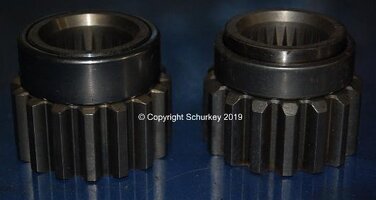
AWD disconnect for Buick Rainier

DIYguybob

Member
Joined
Oct 9, 2024
Posts
18
Location
Ontario
Hi to all, new on the forum, long time GMT owner since 2012. I drive a 2006 Buick Rainier CXL AWD with 4.2L.

From the posts I have read the AWD disconnect is a dummy unit according to Mooseman on AWD vehicles and stays engaged all the time. Sounds like the bearings are shot in mine. I purchased a replacement from Ebay but it came with the actuator which AWD units don't have. I also noticed that Dorman sells two units a 60115 for most GMTs and 60116 for AWD GMTs. The Ebay sellers suggest that their parts will fit all GMTs. Anyone know if this is true? Are they incorrect in their assumption that all these vehicles can use the same disconnect units? Can I use a 4WD disconnect for my AWD?

Thanks in advance!

There is no front disconnect. The one that is there is a "dummy" one, always engaged. Front wheels are always turning the front differential and driveshaft.
 
I think this is the part you are looking for..


600-116 is a completely different part than 600-115

600-116 is for the AWD ONLY vehicles
600-115 is for the 4wd vehicles

They are not technically interchangeable.

You could put a 600-115 on a AWD vehicle, but the AWD will not work.

You could put the 600-116 on a 4wd vehicle, and the 4wd would function as normal, but the axle would be connected at all times, causing more wear and tear, and a slight drop in fuel economy.
 
  • Like
Reactions: xavierny25
You could look at this link and compare.

Parts 11, 12, 13, 14, 16, 17, 18, 19 are replaced by part #5 and #9 for the AWD system.

The actual body parts and bearings, seals and so forth of the unit are the same in both systems.

While the selectable 4 wd system part will fit, it would not transfer any drive power through without some jumper wiring to engage the unit.

It just seems like this would not be adviseable and more prone to early failure.

 
  • Like
Reactions: xavierny25
You could still install it and actuate the actuator motor so it stays connected. It will basically be the same as the non-disconnecting disconnect. I've also seen some versions that just removed the actuator and put a plug with a stem bolted there that would permanently push the fork inside, keeping it engaged.

It would be better if you can return it and get the proper one.
 
Thank you to all for your help. I will return it and buy the correct one. Be careful for those who have an AWD and trust vendors' listings. They seem to think that all GMTs are the same and list the AWD versions as being compatible with the 4WD disconnects. Now I need to do some testing and see if my intermediate shaft is stripped as well. My AWD was not working when I placed all four corners on jack stands. The encoder motor was replaced with a new one and made no difference. I have replaced the transfer case fluid every 50k and recently replaced the front diff fluid. My front drive shaft is turning, but the wheels are not moving much. Sometimes they spin slightly, sometimes not at all. There is also a scaping noise coming from the passenger side near the disconnect. Interestingly I don't hear the scraping noise when the vehicle is driving, only when it's on the jack stands for testing purposes.
 
Once you get the disconnect off, you'll be able to tell if the intermediate shaft is stripped. Happens a lot to the AWD trucks because of the way it engages, which I call the "slip/bang".

 
  • Like
Reactions: xavierny25
That is correct.. Once you pull the disconnect out, you can pull out the cross oil pan drive shaft. If I am remembering correctly, you can even thread in a bolt into the end of the shaft to help you pull it out.

The good thing is, these are pretty much universal across all of the GMT360, regardless of gearing or engine.

Part # 12479125

Available all over eBay, even available on Amazon using that part #.
 
  • Like
Reactions: Mooseman
Thanks TollKeeper, there are a lot on Ebay. Pricing isn't too bad compared to GM's $400 price, I saw many for under $100. Most were new. That tells me this is a common failure part, otherwise why would so many sellers have these on Ebay.

As an option, if I decided to remove the encoder motor and drive in RWD only, would I potentially damage anything else in the front? Could the worn intermediate shaft or worn disconnect cause something to jam and destroy parts?
 
As an option, if I decided to remove the encoder motor and drive in RWD only, would I potentially damage anything else in the front? Could the worn intermediate shaft or worn disconnect cause something to jam and destroy parts?


Even with the transfer case shift motor (encoder motor) removed the components of the front drive system will spin.

Since the drivers side CV axle spins at the rpm of the drivers side front wheel the frictions encountered in the front differential and intermediate bearing assembly (front 'disconnect') will cause rotation of the other components of the front drive system.
 
  • Like
Reactions: Mooseman
Thanks TollKeeper, there are a lot on Ebay. Pricing isn't too bad compared to GM's $400 price, I saw many for under $100. Most were new. That tells me this is a common failure part, otherwise why would so many sellers have these on Ebay.

As an option, if I decided to remove the encoder motor and drive in RWD only, would I potentially damage anything else in the front? Could the worn intermediate shaft or worn disconnect cause something to jam and destroy parts?
I think you should probably make sure to look at that cross pan shaft very carefully.

If the splines are tore up on the disconnect side, make sure you clean the tube in the oil pan out as best you can. Most of the splines are likely going to be embedded in the disconnect, but its best to be sure.

If the splines are tore up on the differential side, do the same as above, but also try to do a dif flush. Put some new GL5 fluid in, drive it for a mile, and drain it again, putting new fluid in again.

Trying to get those filings, and teeth out, to prevent bearing issues later.
 
Thanks Tollkeeper, I appreciate the advice. I need to decide whether to take it apart and inspect, then order parts or order parts and then take apart. I would prefer not to disassemble and reassemble too many times. It will take at least 7 days to get the ebay intermediate shaft. That's a long time with a vehicle down.
 
Hi guys, with all four wheels on the ground I tried to turn the front drive shaft by hand and it spins no problem. Does that indicate a stripped intermediate shaft? I believe it does from the posts I have read.
 
Hi guys, with all four wheels on the ground I tried to turn the front drive shaft by hand and it spins no problem. Does that indicate a stripped intermediate shaft? I believe it does from the posts I have read.


It indicates 'something' is stripped but it cannot isolate WHAT is stripped. It might be the intermediate shaft, it might be either CV axle, it might be the coupler inside the intermediate bearing assembly ('disconnect').

What sounds do you hear while spinning the front driveshaft? And where do these sounds seem to come from?
 
Strangely when I spin the front driveshaft it's quiet. I tested the AWD with all four wheels in the air and that's when I could hear a scraping sound coming from the front right corner. It doesn't seem to make any noises while driving on the road.
 
Given the symptoms, I would suspect the intermediate shaft is stripped, like in that thread I linked. Likely both the disconnect and shaft will need to be replaced. This is just an educated guess though and won't be confirmed until it's all taken apart.
 
You could look at this link and compare.

Parts 11, 12, 13, 14, 16, 17, 18, 19 are replaced by part #5 and #9 for the AWD system.

The actual body parts and bearings, seals and so forth of the unit are the same in both systems.

While the selectable 4 wd system part will fit, it would not transfer any drive power through without some jumper wiring to engage the unit.

It just seems like this would not be adviseable and more prone to early failure.

Bearing "2" is the one that's given me repeat problems--the original disconnect, and the "rebuilt" one that I bought to replace the original. Both failed the bearing on the "gear", and destroyed the machined surface of the gear in the process.

My "fix" for that is to NOT use the "official" bearing on the side of the housing that the "gear" rides on. I use a 16mm bearing instead of the 12mm bearing. The wider bearing JUST BARELY fits into the OEM aluminum housing. Whether it fits on the aftermarket housings, I don't know.
2022 Trailblazer Disconnect bearing-gear_02.jpg

2022 Trailblazer Disconnect bearing-gear_03.jpg

The AWD version of the "disconnect" uses the same bearings, and I bet has the exact same failure mode. A wider bearing in the same location--maybe both locations--would minimize repeat failures. But since I've never had an AWD "disconnect" apart, I can't say for sure that the wider bearing would fit in either place.
 
  • Like
Reactions: Mooseman
AWD is working again!!

Hi to all, I know it's been a while, but I finally got a new intermediate drive shaft and the correct AWD disconnect for the Buick Rainier. It uses part number 600-116 (not 600-115). This part is for vehicles that do not have any controls on the dash for AWD. Bought the drive shaft for $50 US on eBay part number 12479125, new with 10 year warranty. Bought the disconnect on Amazon for $125, 1 year warranty. US. https://www.amazon.ca/dp/B09JK7C9GP/?tag=gmtnation-20

So for under $200 US was able to repair my AWD, here is how I did it:
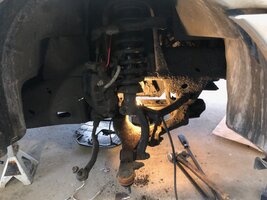
I recommend you remove the steering knuckle to gain awesome access. It took me about 20 mins to remove. Jack up front of vehicle on jack stands, remove the wheel, axle nut (loosen prior to jacking if you don't have an impact gun), remove entire caliper assembly and hang off spring. remove rotor, disconnect ABS cable from knuckle and hub. Next disconnect the tie rod end, lower ball joint nut, upper control arm pinch bolt. Now the entire knuckle can be removed and set aside.

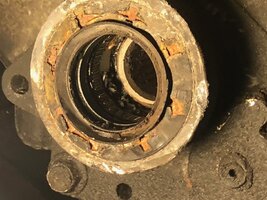
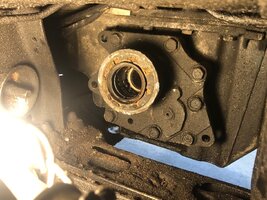
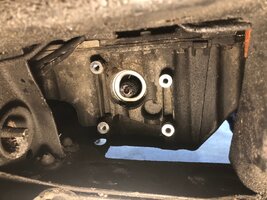
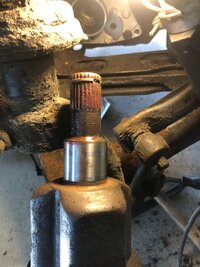
Not sure why, but I had a hell of time getting the CV axle to pop out. I had a slide hammer CV puller that's 3 feet long and pretty heavy duty. Nothing. It would not budge. I ended up removing the plastic access cover under the engine and accessing the CV axle from there. Used a wide mouth fork and a sledge hammer to release the CV axle. Worked well. See pictures for more info.

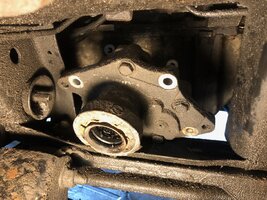
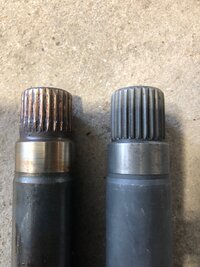
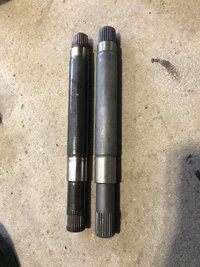
After setting aside the CV axle, I removed 4 bolts from the disconnect. Do not remove them all. Some keep the housing together, some mount the housing to the differential. See my pictures, it shows which need removing. The rest stay on. I used a solid metal pipe and a hammer to knock out the disconnect from the access under the front engine. It is not easy to pull this out from the differential cover. Best to knock it out with a hammer and metal pipe from the inside out. Next pulled out intermediate drive shaft out by hand, came out no problem. The old one looked worn, not sure if it's terrible. Look at the photos and judge for yourself. Personally I would not take the chance for $50. Cleaned up the surface that the disconnect mated to in differential case with sandpaper and a rag with carb cleaner, then applied a small amount of grease on mating surface of new disconnect. Slid right in, no problems. Cleaned up end of CV axle prior to reinstalling (it was gummed up with old grease) and used new grease on splines. See pictures. Slid it in, ensuring that it locked into place.

Reinstall knuckle, ABS wire, axle nut, rotor, caliper assembly, wheel and you are done. Total time was about 5 hours, 1 hour was spent fighting the CV axle. If I did it again I think 2 to 3 hours would do it. I would also recommend an impact gun for the job. It comes in very handy for the axle nut, tie rod end, ball joint nut, lug nuts. For me, a fork to separate the CV axle was also crucial for the job. Finish off the job with draining and refilling the differential fluid, who knows what ended up in the fluid during this mechanical failure.

If you are an intermediate or higher DIY person you can do this job. Make sure you have the correct parts and the tools you need. I saved about $1000 to $1500 by DIYing it. That is worth 5 hours of my time. Hope this helps some of you out there. The only difference with the non automatic AWD systems is that the disconnect has a solenoid on it which means you need part number 600-115 instead of 600-116. Other than that it should be the same as this one.

Thanks to the experts on the board for your help, couldn't have done it without you!
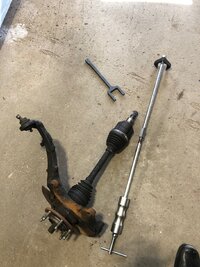
IMG_5115.jpgIMG_5116.jpgIMG_5117.jpgIMG_5118.jpgIMG_5119.jpgIMG_5120.jpgIMG_5122.jpgIMG_5123.jpgIMG_5124.jpgIMG_5125.jpg
 
Nice job! That shaft was stripped, which was the primary reason of your AWD failure. The Disconnect may have been OK but most times, when that shaft strips, it sends metal shrapnel in it and destroying it too.

I'm adding this to the Drivetrain FAQ.
 
Nice job! That shaft was stripped, which was the primary reason of your AWD failure. The Disconnect may have been OK but most times, when that shaft strips, it sends metal shrapnel in it and destroying it too.

I'm adding this to the Drivetrain FAQ.
Thanks Mooseman. The grease was pretty dried out inside the disconnect. I think the right move was to replace both. I recently had to do the seal on the driver side. Hopefully I am good for at least another 10 years!
 
  • Like
Reactions: Mooseman
When I replaced the disconnect on my '04 TB the CV axle wouldn't come out either. You can cut the large CV axle boot clamp and pull the rest of the axle out, then remove the disconnect with the stub still in it. Remove the stub from the disconnect at your workbench. You can get a new clamp and reassemble the axle, or replace the axle with a new one, which is what I did. The shredded disconnect bearing didn't do the splines any favors!
 

Forum Statistics

Threads
24,253
Posts
648,441
Members
20,695
Latest member
aro_hero

Members Online