DIY Front Wheel Alignment, 2005 GMC Envoy

Camdo

Member
Joined
May 16, 2015
Posts
96
Post 1 of 5

DIY FRONT WHEEL ALIGNMENT

Keywords: Tire alignment, caster formula, caster derivation, caster equation, caster math, 850219, Toolwiz, caster-camber gauge, caster/camber, caster / camber, Caster – camber, caster-camber, SAI


Vehicle 2005 GMC Envoy, 4X4, SLT, 4.2L, coil spring suspension (short wheelbase)

Replaced 2 lower control arms, 2 upper control arms, left and right tie rods. Final positioning of the lower control arms was set at furthest inward position. Alignment was going to be way off factory specification. Plan was to purchase new tires and have the tire shop do a professional alignment.

In the past, my vehicle was aligned three times by a trusted tire shop. The first time, 7 years ago, after purchasing new tires, the alignment report was good and my vehicle drove great. The second time, 6 years ago, after replacing ball joints and tie rods, the alignment report had 1 red box on it. They said camber was not adjustable, it’s the way things are, nothing to be alarmed about. Not knowing any better I accepted their statement. After all they were the experts and I trusted them. The third time, 2 years ago, after replacing tie rods, the alignment report had a lot of red on it. They said “The bolts were rusted and could not adjust camber and caster. It’s nothing to worry about”. Now I know something is wrong since the last time they said it was not adjustable and now they say its rusted inferring it could be adjusted, but not practical to do so. My vehicle is 20 years old and it probably is rusted, so I accepted their excuse.

Now at present, I have replaced the lower control arms and found the bolts were not rusted, and the chassis pockets the arms fit into were not rusted. I know now, the tire shop I had dealt with for the last 7 years was being deceitful, as they told me it was rusted and not adjustable. I will not go there again. There should be no excuse for another shop to adjust caster and camber.

I searched for tire shops that do alignments and found they all looked the same. So I went to a big box shop that advertised on TV and went to the back to talk directly to the alignment guy. I pointed to my Envoy and asked if he had experience aligning that model. He said many times, but this shop did not have many tools and I should go to another branch 20 miles away where he was transferred from. Okay, I went to that branch and told them of the recommendation and they knew that guy well. It was good luck that I was talking to their alignment guy at the front counter. He told me the Envoy will be brought to factory specification and I would not have to pay if it was not. He was trained to work on my vehicle, and he had the tools to do the job. This is great, I thought and made an appointment for new tires and alignment.

During the alignment, I walked in back to see it being performed. I asked the guy doing the work (the same guy who took my order and made all the promises and assertions) if he had the tools to work with 200 lb-ft of torque. He told me he “Had no problems with the job” and not to worry. The laser beams were flashing and it all looked very professional and exacting. The sign said “No customers in the service bay”. I went back to the waiting room.

I get the call, “all done”, and the desk clerk says “Wow it must have been way out of align. Looks good now”. He runs thru the things and features I purchased and motions me to pay the total and so I do. Then I glanced at the alignment report. 1 red box, Left Camber +1.00 . “It’s out of spec” I said. “Oh, It’s not adjustable. Nothing to worry about. If it was a problem he would have fixed it”, he said. The only thing they adjusted was toe. Everything else was untouched. The control arms were where I left them, at maximum inward positions from the install.

I left the tire shop disappointed. My vehicle does not drive well. It is touchy to dig into a curve at the touch of the steering wheel. I had been had. Thinking of what was said, they had not exactly lied to me. They aligned ‘toe’ to factory specification and he had the tools to do it. Deceitful, but not a lie. I am no match against experts of deception. I was beaten.

I resolved to align the vehicle myself. I want to know the true state of alignment and not waste any more money. I looked forward to the challenge. I will do the best job I can with common tools and for low cost . I began reading up on the subject. Watched YouTube videos and read forums and manuals and scanned merchant’s tool offerings.


THE FORMULA FOR CASTER

There are several formulas and procedures floating on the internet for determining caster angle. To determine which is correct, I must see a complete derivation using first principles of engineering. An excellent study titled “Steering Geometry and Caster Measurement”, Daniel B. January, Hunter Engineering Company, Bridgeton, Missouri, 1/30/1985. Has been reprinted with permission from the SAE Technical Paper Series 850219.

https://disco3.co.uk/gallery/albums/userpics/24543/steering-geometry-and-caster-measurement[1].pdf

In the paper, we can see the derivation of the caster angle formula and a procedure to use it.

From the paper

Definitions: K = caster angle, T1 = steering angle from thrust line of vehicle defined as negative when front of tire rotated outward, T2 = steering angle from TL defined as positive when front of tire is rotated inward, T = T2 = -T1 (the symmetrical steering angle without regard for sign), All variables K, C1, C2, T1, T2, T are in degrees. The caster turn is steering from (straight ahead)T0 to T1 to T2.

K = arctan((sinC1 – sinC2)/(sinT2 – sinT1) eq(7)

Equation(7) is the exact equation for Caster Angle with the limitation that camber angles are small (less than 2 degrees), and the caster turn is symmetric about the thrust line.

If slight deviation from exact is allowed, equation(7) can be further simplified to:

K = 180 / pi *((C1 – C2) / (T2 - T1)) eq(8)

Another formula commonly found on the internet is also a simplification of Eq(7):

K = (C1 – C2) / (2 * sinT) eq(a)

The derivation of eq(a) can be found in a following post as a footnote.

All three formulas give essentially the same answer within the bounds of common vehicle alignment angles.

Example1

C1 = +1.55 C2 = -1.25 T1=-20 T2 = +20

Eq(7) K = arctan((sin(+1.55) – sin(-1.25))/(sin(+20) –sin(-20)) = 4.085

Eq(8) K= 180 / pi * ((+1.55 – (-1.25))/(+20 –(- 20)) = 4.010

Eq(a) K= (+1.55 – ( -1.25) / (2 * sin(20)) = 4.093

Example 2

C1 = 0.75 C2 = -0.60 T1=10 T2 = -10

Eq(7) K = 3.881
Eq(8) K=3.867
Eq(a) K=3.887
The three equations give essentially the same result for small camber angles commonly within the steering range.

Equations (8) and eq(a) can be simplified further to If the steering angle is always going to be +/- 20 degrees symmetrical:

Eq(8) simplifies to:

K = 180/pi*(C1-C2)/(T2-T1) = 180/pi*(C1-C2)/(20--20)

K = 1.432 * (C1 - C2) Eq(8a)

And eq(a) simplifies to

K = (C1 – C2) / (2 * sinT) = (C1 – C2) / (2 * sin20) = (C1-C2) / .6840

K = 1.462 * (C1 – C2) Eq(b)

Either equation eq(8a) or eq(b) can be used for vehicle alignment with limitations: Steering angle +/- 20 degrees is symmetric to thrust line, small camber angles less than 2 degrees are encountered in the caster turn. I chose eq(b) to use in my alignment as it seems to have a very slight edge in accuracy for the angles Envoy uses.


Alignment procedure:

1. At 0 degree toe measure camber. Toe at zero degrees is measured from the thrust line which is the stance of the vehicle tracking forward in a straight line.

2. Turn left front wheel T1 = -20 degrees as in making a left hand turn. Front of tire faces outward.

3. Measure camber C1.

4. Turn wheel back to 0 toe.

5. Turn Left wheel T2 = + 20 degrees as in making a right turn. Front of tire faces inward.

6. Measure camber C2.

7. Return wheel to 0 toe.

8. Calculate left front caster: K = (C1 – C2) * 1.462

9. Repeat for right side.

10. At 0 degree toe measure camber.

11. Turn right front wheel T1 = -20 degrees as in making a right hand turn. Front of tire faces outward.

12. Measure camber C1.

13. Turn wheel back to 0 toe.

14. Turn right wheel T2 = + 20 degrees as in making a left turn. Front of tire faces inward.

15. Measure camber C2.

16. Return wheel to 0 toe.

17. Calculate right front caster: K = (C1 – C2) * 1.462


  • Avoid hysteresis error by approaching the target steering angle from the same rotation sense. For example in step 2, overshoot the -20 degree target and then return clockwise to -20. Then is step 5 turn clockwise to +20 degrees without overshoot. That will load the suspension components consistently so C1 - C2 is accurate without hysteresis error.
Continued in Post 2
 
Post 2

DIY FRONT WHEEL ALIGNMENT


  • TOOLS

  • CAMBER GAUGE

  • Camber gauges can be pricy, but some are surprisingly inexpensive. Rather than spend a few hundred dollars on a good one, I would evaluate a cheap one costing just $12. Nothing to lose for that price.

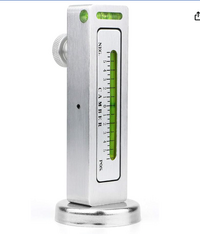
  • I got a Toolwiz Camber Gauge from Amazon.com
  • https://www.amazon.com/dp/B07LG1TMTZ/?tag=gmtnation-20

  • insert ToolWiz.png
  • ToolWiz.png

  • I was impressed with the quality and feel of the gauge. It is all metal, very rigid perpendicular to the magnet and well made. The tilting scale is backlash free and the bubble sensitive to slight level changes. Graduations are presumably in half degrees although there is no definitive statement that the graduations are degrees. The magnet is strong.

  • I used the gauge to check my vehicle. I followed the Toolwiz instruction procedure. Measure camber at zero toe, turn wheel 20 degrees outward, zero gauge, turn wheel 20 degrees inward (40 degrees total), read caster. Results did not match the tire shop laser alignment measurements. This got me thinking about calibration and accuracy. Neither the tire shop or Toolwiz provide certificates of accuracy or calibration test records, or make any claim of accuracy or repeatability. A $12 Toolwiz that measures reliably to fractions of a degree is suspect. A $50,000 laser alignment machine must be right, but the tire shop doesn’t adjust caster and camber so what do they care if their machine is out of spec, or maybe fudged to make caster and camber look good even if it is not. I must calibrate the Toolwiz to known standards. I must have assurance that the gauge I am using is measuring accurately and repeatably.

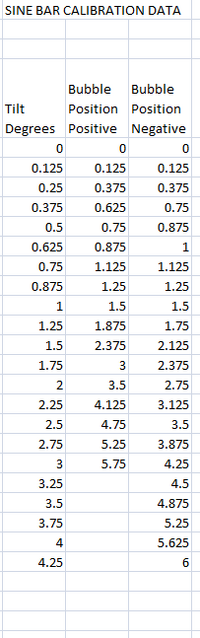
  • I checked the Toolwiz scale accuracy with a machinist’s sine bar and precision gauge blocks accurate to a fraction of 1/10000 of an inch. The Toolwiz scale was found to be not accurate al all.. To test Toolwiz calibration, I mounted it to a precision right angle block and set it on a sine bar which was resting on top of a precision flat surface. Toolwiz was zeroed using its tipping scale adjuster knob. Gauge blocks were then inserted under the sine bar pivot to tip it in 0.25 degree increments. The Toolwiz bubble was then read and recorded. The gauge block was then moved to tip the bar in the negative direction and bubble position recorded. In the end I had a table of tip angles and corresponding Toolwiz readings. The results are shown in picture below:

  • Insert pic : SineBarCal
  • SineBarCal.png


  • Toolwiz has one vial that must measure camber in degrees tilt and caster which is a factored (1.462) measurement of tilt. Most camber / caster gauges have three vials to accomplish this task but Toolwiz is doing it with just one vial. Maybe the vial is contorted in some magical computational manner, or maybe there is an inherent acceptable error at small angles, or maybe there is some other logic at work. The bottom line is, I used it as directed and got results that I did not trust. Having made the table above I cannot trust it or understand what it is doing. I can see some factoring but not accuracy. The makers do not provide any explanation of theory or calibration procedure. The scale label ‘Camber’ is misleading. I wish they made the scales in simple tilt degrees and let the user do the simple math to calculate caster. That would be working closer to first principles rather than stacking error upon error. I did find that for any particular tilt, the bubble came back to the same position shown in the calibration table, so it was repeatable. What is needed is a table to convert Toolwiz readings to correct calibrated readings.

  • Toolwiz is graduated in half degree increments and it is possible to read the bubble between graduations for quarter degree readings, and it is also very easy to tell if the bubble is slightly before or after the quarter degree for readings for eighth’s of 1 degree. It would be very tedious to calibrate every eighth degree so I decided to calibrate every quarter degree and interpolate mathematically for eighth degree increments. To do so, a list of 1/8 degree increments is made on an Excel spreadsheet and a macro will interpolate the above table values to fit within list increments. Here is the Excel macro:

  • insert file macro
  • see Module1.txt in files section below


  • Below is the resultant table of interpolated values fitted to the eighth degree list for positive and negative tilts.

  • Insert Pic Interpolation
Interpolation.png


  • With the above table, I can read the Toolwiz bubble to 1/8 degree and use the table to convert that reading to a correct tilt angle.

  • Before Toolwiz can be used to measure camber, it must have its tilting scale adjusted to absolute level on a surface of greater level precision than the finest graduations on the gauge scale, which is one eighth of a degree. So the gauge should be zeroed on a surface of 4X greater precision which would be 1 quarter of one eighth degree or +/- 1/32 degree or +/- 2 arc minutes or +/- .033 degrees. To obtain that fine a level surface would require a precision machinist’ level, and a precision right angle block.

  • To do this, a precision machinist level is set on the sine bar and a shim inserted underneath one of the pivots to obtain level. The machinist level is then rotated 180 degrees and if the sine bar is level, the bubble will still be centered. I had to place a 0.002 inch feeler gauge under one end of the sine bar to level it. The Toolwiz and right angle block is placed on the level sine bar and the tilting scale of Toolwiz adjusted to zero the scale. The assembly is then rotated 180 degrees and bubble should still read zero.

  • Note that the right angle block must be accurate. The base of Toolwiz is 2 inches diameter and we must be perpendicular to a fraction of .033 degrees let that be 4X better or 0.00825 degrees. Right angle block must be perpendicular to 2 * sin(.00825) = .00028 inch or 3 tenths / 2 inch. This is within the range of standard tool room 123 blocks.


  • Insert pic DSC_0030.JPG
  • DSC_0030.JPG


  • Toolwiz is now ready for use. It has been calibrated and zeroed to absolute level. It will be used as an inclinometer to measure camber and caster by equation(b). The instructions that came with Toolwiz will be discarded. The tilting scale will be left at absolute zero and handled carefully to avoid bumping the adjustment knob which would require re-zeroing on the absolute level of the sine bar.

  • Relative Mode Camber Measurement
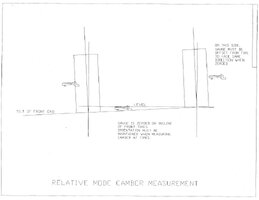
  • An alternative to setting Toolwiz to absolute level, is to measure camber in relative mode. To do so, set Toolwiz on a straight surface of same incline of the front tires of the vehicle. Adjust the scale to zero using the leveling knob. Make note of which side (left or right) the Toolwiz base is towards. Camber can be measured so long as the Toolwiz base is orientated towards that same side. Now imagine the tires, in the picture below, have a negative camber (tops of tires tilt towards each other), Toolwiz will read negatively if its base is towards the tire, and positively when the base is away from the tire. The Toolwiz sign is inverted for those cases. The advantage of relative mode is it does not require a precision machinist level or absolute level calibration, but the camber jig must have pins long enough to accommodate Toolwiz inside the pins, and a straight bar will be required to set the relative tilt. Here is a picture to visualize the relative measurement technique:
  • Insert pic RelativeMode.JPG
  • RelativeMode.jpg


  • Camber Jig
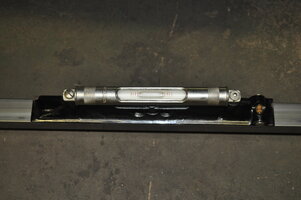
  • The jig to make camber measurements is simply a straight metal bar with two pins to offset the bar from the wheel rim. Long pins are desirable so Toolwiz can be read top down without skew or interference from the vehicle fenders . The bar is simply ¼ x 1 hot rolled steel and the pins are ¼-20 x 6 inch bolts with the heads sawn off and rounded set 17.5 inch O.C. on the bar. Flatness of the bar is critical. I checked mine against a precision straight edge purchased to detect warped cylinder head surfaces, but alternatively, two flats rotated 180 degrees will detect flatness of the two surfaces. The bar was drilled so the pins would fit on the flats of the rim circumference. The pins were then adjusted to be exactly equidistant to the bar surface. I used a dial gauge set up but alternatively, a C jig with feeler gauges could be improvised (like measuring tappet clearances). Note this jig cannot be used in relative mode, because the pins are too short. The jig is shown below:
  • Insert pic DSC_0019.JPG
  • DSC_0018.JPG

  • Error Budget
  • Every metrology system has an error budget. System accuracy is the total of the component errors.

  • Error Budget = E(blocks) + E(sine bar) + E(surface) + E(right angle) + E(bar pins) + E(bar straightness) + E(gauge read) + E(rim placement) + E (vehicle tilt)………..etc.

  • Every setup has its own error budget. The measurement is only as good as the gauge and the jig it is mounted to and the stance of the vehicle.

  • Camber specification of the Envoy is -0.50 degrees . If that is divided equally among the above 9 error budget components, each would require accuracy of ( one half of 0.06) or +/- .03 degrees. We can see the need to keep everything as accurate as possible.


  • Cost of Calibration
  • The calibration tools I used could be had for about $233 as follows:
  • Gauge block set $118
  • https://www.travers.com/category/space-block-sets
  • Sine Bar, 5 inch $49
  • https://www.travers.com/category/sine-bars
  • Precision Shop block 123 block $31
  • https://www.travers.com/category/setup-blocks
  • Caliper, 6 inch $35
  • https://www.travers.com/category/dial-calipers
  • optional precision machinist level $143 (not required using relative mode camber measurements)
  • https://www.travers.com/category/plumb-line-levels
  • A suitable work surface could be a piece of double thick plate glass 6 x 12
  • Feeler gauge set

  • One could spend $200 on a good camber / caster alignment tool, but calibration would still be required or else rely blindly on the manufacturer. Might as well buy an inexpensive camber gauge, like the Toolwiz, and calibrate it yourself.

  • Some additional notes:
1. Buy a camber caster gauge that is calibrated at the factory and preset true to level. It will come with signed accuracy certificates. I have yet to see one

2. Buy a machine shop inclinometer with signed accuracy certificates. Very expensive ($600)

3. Low cost ($100) digital inclinometers have two accuracies. One at zero incline and another at all other angles. All other angles is usually +/- 0.2 degrees which is unsuitable for camber measurement. Despite the stated accuracy at 0 degrees the limitation is the readout, 0.1 degrees . You will still need to verify the accuracy and repeatability for assurance.

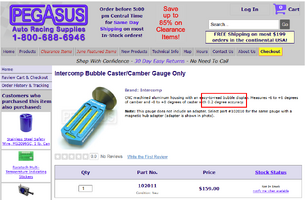
4. Racing supply outlets seem to carry the better gauges: Pegasusautoracing.com Summitracing.com joesracing.com but regardless of price or look demand accuracy specs.

Insert pic Intercomp
Intercomp.png


Insert pic Longacre
Longacre.png


5. You still need tools to level the vehicle or measure the line of inclination of the front tires. The garage floor may not be straight or level. Some gauges allow resetting the zero and so camber measurements can be relative to the incline. But the garage floor next to the tire is not the line of inclination between the front tires.

6. A precision right angle block is required with all the setups.

7. Have a machine shop calibrate your gauge (estimate $200).


  • Vehicle Stands
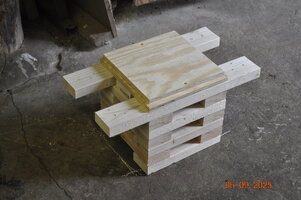
  • Another tool necessary is a vehicle stand with turn plates. It is necessary to work under the vehicle to make adjustments so higher is better, but garage height was my limiting factor. I constructed stands of 2 x 4 x 12 inch lumber from scraps at a construction site, and screwed them together, 2 / 2.5 inch screws to a joint. Screws were used so future height adjustment could be done. Turn plates were made of 3/4 plywood cut 12 inch diameter with a 4 inch flat for angle reference (not shown). Under the disc, 4 layers of kitchen trash bags provided lubricity, which worked very well. The rear tires have two, layers of 12 inch square plywood for height consistency with the front stands. An assortment of 12 inch square materials of 1/4 plywood and 1/8 masonite for adjustment purposes to level the vehicle. Fine shims were made from cardboard cereal boxes.
  • Insert pic DSC_003.JPG
  • DSC_0003.JPG
  • An improvement can be had by making the disc the stationary plate of 1/8 masonite, and the turn plate a 14 x 18 rectangle. That would provide a better surface to rest straight edges for measurement of front end tilt.

  • Rear Wheel Stand with tire chock shelf
  • Insert pic DSC_004.jpg
  • DSC_0004.JPG

  • The stands had to be reduced from height shown as I could not open the roll up garage door. Chock blocks screwed to the 2 x 4’s from underneath were added after the vehicle was placed on the stands. I had my doubts, but the vehicle was very stable on the stands.
  • Insert pic DSC_0009.JPG
  • DSC_0009.JPG

  • Laser Level, Self leveling
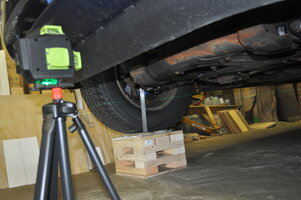
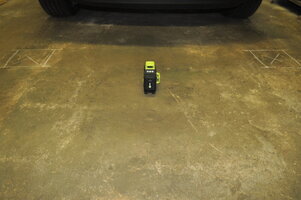
  • The laser level I used to level the vehicle and make accurate toe measurements was an inexpensive one from Amazon.com. I checked it against an expensive Bosch unit and found the lines to be coincident at 30 feet. The quality was good and useful for the construction purposes I got it for. It was very handy for the alignment job. Here it is:
  • Insert pic LaserLevel.png
  • LaserLevel.png


  • TOE BOARDS
  • To measure toe, I used two pieces of 1 inch thick cedar decking. It is very light weight, flat and straight. I could mate the two boards together and not see air and then rotate them 180 degrees and still not see air. Proof of flat and straight. A bungee cord ball loop was used to tie the toeboard to the wheel rim.
  • Insert pic DSC_0008
  • DSC_0008.JPG


  • Continued next post 3
 

Attachments

Post 3

DIY FRONT WHEEL ALIGNMENT


  • BEVEL GAUGE
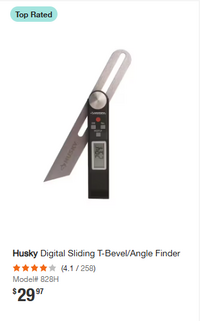
  • Something is needed to measure the steering angle when making caster measurements. The turn plates move sideways as the tire turns adding to complexity in measuring the steering angle which should be done relative to the thrust line of the vehicle. I knew the steering wheel of my vehicle was just a few degrees to the side when driving a straight line. That was my zero reference. With the steering wheel at the zero position, the flat of the turn plate (not shown) was measured relative to the stand. The digital bevel gauge was zeroed with the wheel in straight ahead position and the steering angle measured relatively from that position. The digital bevel gauge I used was a Husky from Home Depot ($30).
  • Insert pic BevelGauge.PNG
  • BevelGauge.png

  • Jounce Jig
  • After each adjustment, it is important to jounce the front end at least 5 times of 1.5 inch amplitude. This dissipates internal stresses which can affect alignment measurements. To accomplish the jounce I used the jig shown below. It can be much improved if the bar is fastened to the post with a captured pivot. It would be worth the effort to make a better contraption in the future.
  • Insert pic DSC_0012
  • DSC_0012.JPG


  • ALGNMENT PROCEDURE - ABSOLUTE MODE
  • With tools in hand, the actual alignment can proceed.

  • 1. The vehicle was driven into the garage bay and the footprint of the tires marked with chalk on the floor.

  • 2. Vehicle stands were positioned over the tire footprints and height adjusted with the self leveling laser level. Chalk marked the stand positions.

  • 3. The vehicle was then driven in and rear tires placed on the stands. Chock blocks were screwed in place in the rear. The front was then lifted onto the front turn plate stands.

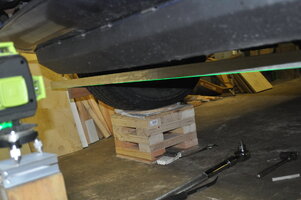
  • 4. With vehicle weight on the stands, they were leveled with the laser level and ruler to within 1/32 inch front to rear and 1/64 inch front tilt. Cereal box cardboard was used for fine shims. Error budget front tilt of 1/64 inch on 61 inch track width is = arctan(.015 / 61) = .014 degrees. Caster error budget of 1/32 on 113 inch wheelbase is = arctan(.031 / 113) = .016 degrees
  • Insert pic DSC_0021.JPG
  • DSC_0021.JPG

  • I confirmed the front tilt with the Toolwiz in absolute level. It read perfect level. Rotated Toolwiz 180 degrees on the bar, and it still read perfect level. Even though the bar sags a bit, so long as Tool wiz is centered on the bar it will detect tilt. This also confirmed the accuracy of the self leveling laser level. In retrospect, I should have rotated ‘the bar and Toolwiz’ 180 degrees to confirm levelness.
  • Insert pic DSC_0027.JPG
  • DSC_0027.JPG


  • 5. Measure Z and D height to check the vehicles stance per the manual.
  • Left Right Specification comment
  • Z height 3.18 3.38 2.6 to 3.54 ok
  • D height 5.62 5.62 5.88 to 6.35 slightly low
  • D height was measured vertically from rear axle tube top to frame, and not to the bracket shown in manual.


  • 6. Tire pressure was adjusted to 30psi front and 35 psi rear.
  • to the bar. It required careful handling to avoid bumping the adjustment knob.

  • 8. Alignment Terms
  • Insert pic AlignmentTerms
  • AlignmentTerms.png

  • 7. Set Toolwiz to absolute level on sine bar and transfer to the caster jig and square it


  • 9. I settled on a system of nomenclature to record measurements that I found very helpful to avoid confusion and repetition. All Toolwiz bubble readings were suffixed ‘g’ and the corrected interpolated angle as ’c’.

  • Caster measurements were recorded in same sequence as C1 – C2 in eq(b).
  • For example L.Caster = [C1-C2]*1.462 = [2.75g = 1.65c , -1.25g = -0.88c] * 1.462 = [+1.65c - -0.88c]*1.462 = 2.53c * 1.462 = 3.69c degrees.

  • It is essential to mark each dimension as g or c to avoid confusion.

  • Toe adjustments were recorded by number of nut flats in direction of reducing or increasing toe. So +2F means turn the inner tie rod 2 hex flats in direction that will increase toe (an outward direction).

  • 10. If large adjustments were made to the lower control arm position, toe should be measured and adjusted first to be reasonably close to spec, as it affects camber and caster. Toe was adjusted to spec when I purchased the new tires. To keep that thrust line, I worked on one side only and brought toe to spec before working on the other side.

  • 11. To measure toe, set the toe boards as shown.
  • Insert pic DSC_0007.JPG
  • DSC_0007.JPG


  • Make sure they are not on any raised lettering on the tire. An improved toe board would rest on the rim flat, but I did it this way this time. A bungee cord works nicely to hold the toe board against the tire while allowing height adjustability.

  • Use the laser level to set the two toe boards at equal planar height. I placed an aluminum angle on top of the toe board to use as a leveling aid on the rear tire side of the tire and the laser picked up the toe board on the front side.
  • Insert pic DSC_0032.PNG
  • DSC_0032.JPG


  • Duct tape was used to mark the position of the toe boards on the tires. This is an important time saver since the toe boards have to be removed to make camber and caster measurements.

  • A wide tape measure was used to make a straight line touching the tire crowns and toe board tops. The line is marked on the toe board. This is repeated on the front side of the tire. The distance between marks is the length of the triangle side, the angle of which is the specified total toe in degrees. Total toe is measured as the difference in width along the toe board marks(see picture in step 8). In actuality, an aluminum angle of same thickness as the crown of the tape measure was used to make the marks, being moiré accurate and easier to handle than a tape measure. The distance between marks was 26.5 inches.

  • Total Toe specified in the manual is 0.10 + / - 0.20 degrees. Assuming thrust angle is zero.
  • Toe is therefore 26.5*Tan(.1) = .046 inches
  • High limit Toe is 26.5*Tan(.3) = 0.138
  • Low limit Toe is 26.5*Tan (-.1) = -.046

  • The difference between rear and front toe board measurements should be .046 inches. That is actually easy to see on a 1/16’th scale tape measure. One half of a grad plus half of a half or 1/32 and 1/64. I had no problem reading it. The toe boards need sharp edges and the tape measure clean. An improvement could be had using a board and pin with a caliper’s depth rod, but I was cramped for space. It should be noted that the ‘mark’ distance can be the entire toe board length so long as the ends are square to the board on the opposite side. Longer toe boards will give increased accuracy.

  • After toe is measured, the toe boards are removed so camber and caster can be measured. Very tedious, but doable.

  • 12. With the steering angle at zero degrees, measure camber. Hold the caster jig so the pins rest on the flat of the rim in a vertical orientation. Record the measurement as suffix ‘g’ and look up the corrected angle in the table and record that as suffix ‘c’.
  • Insert pic DSC_0018.PNG
  • DSC_0018.JPG


  • 13. Measure the position of the turn plate with the bevel gauge and reset it to zero. Turn the steering wheel so the front of the wheel points outward from the vehicle side to a position T1 = -20 degrees from straight ahead. Measure and record the camber (C1) at this position. Rotate the steering wheel back to straight ahead (zero angle) and continue turning so the front of the wheel points inward at T2 = 20 degree angle. Measure and record the camber (C2) at that position. Return the steering back to zero. Use corrected gauge angles to calculate Caster = (C1 – C2) * 1.462. Paying attention to the sign of the angle.

  • 14. Toe, camber and caster are all dependant on each other. An adjustment of one will affect the other two. It is most expedient to get toe and camber in spec first and do caster last. If the three are close to specification then the affect of one on the others is less pronounced.

  • 15. After an adjustment was made and before any measurement taken, the front of the vehicle was jounced 5 times of at least 1.5 inch amplitude with the jounce jig, to distribute residual hysteresis in the suspension. After toe adjustments the front tire was jerked side to side and then the chassis jounced as described.

  • 16. Good notes are essential.
  • I used pictorial notation so I could remember what was done and where I was going. Here is a sampling:
  • Insert pic AlignNotePg1
  • AlignNotesPg1.png
  • Insert pic AlignNotePg2AlignNotesPg2.png

  • After a while I only drew the ovals and bolt position within the oval. In all, I made 8 pages of notes but the early pages were not very good and I could not retrace my steps. This lead to wasted time and confusion. Be sure to record the tools and methods in addition to the measurements taken.

  • 17. Adjusting the position of the lower control arm bracket requires a pry bar and some jack blocks to pry against the frame. I had an assortment of 0.5 wide x 2 inch long steel bars in varying thicknesses of .50, .38, .31, .25, .18, .12 inch. I used just about all of them sometimes together to gain the ideal pry fulcrum. Care must be taken not to insert the jack blocks too far into the frame to avoid touching the bracket. I found an 18 inch Harbor Freight pry bar most useful. Ground clearance was an issue with longer bars.

  • 18. After an adjustment of camber and caster, the 3 lower control arm bracket bolts were lightly tightened and measurements taken. Final bracket torque is 192 lb-ft on the one front bolt and 177 lb-ft on the two rear bolts. Alignment was re-checked after final torque of the bolts, nothing changed.

  • 19. All done. Start it up and drive away. Nope. Dead Battery. I had drained the battery leaving the keys in the ignition so I could turn the wheels for caster measurements. My 6 amp charger could not revive it, but thankfully, Advance Auto Parts was able to bring it back to life (it was on warranty), no charge. Thank you Advance Auto Parts.

  • 20. Results: everything in spec.

  • All dimensions in degrees
  • P = pass F=Fail
  • BEFORE

  • Code:
    [*]     LEFT                            |  RIGHT
    Camber  +0.50  spec -0.50+/- 0.60   | F |  +0.38  spec -0.50 +/- 0.60  | F |
    Caster  +4.69  spec +3.75 +/- 0.60  | F |  +4.42  spec +4.25 +/- 0.60  | P |
                        Total Toe  +0.25  spec +0.10 +/- 0.20  | P |
    [*]


  • AFTER
  • Code:
    [*]     LEFT                            |  RIGHT
    Camber  -0.29  spec -0.50+/- 0.60   | p |  -0.50  spec -0.50 +/- 0.60  | P |
    Caster  +3.69  spec +3.75 +/- 0.60  | P |  +4.09  spec +4.25 +/- 0.60  | P |
                        Total Toe  +0.10  spec +0.10 +/- 0.20  | P |
    [*]

  • Note: Left camber was at limits of adjustment.

  • 21. As an afterthought, 8 days and a few hundred miles later, I went to another branch of the tire shop where I purchased the tires and alignment. I showed them the receipt and alignment sheet and pointed out that the alignment they did was not to factory spec and that the vehicle did not drive to my satisfaction and that I had to align the vehicle myself. I asked if they would re-check my alignment on their fancy laser machine. Without hesitation they agreed to do it for free. Here are their measurements:
  • Code:
             LEFT                            |   RIGHT
    Camber   -0.7   spec -0.50+/- 0.60   | P |   -0.2   spec -0.50 +/- 0.60   | P |
    Caster   +3.8   spec +3.75 +/- 0.60  | P |   +3.8   spec +4.25 +/- 0.60   | P |
                        Total Toe   +0.12   spec +0.10 +/- 0.20   | P |
  • 22. Concerned about the discrepancy in camber measurements 12 days later I re-measured using “Relative Mode” technique (described in a following post). Here is the result:
  • Code:
            LEFT                             |  RIGHT
    Camber  -0.33   spec -0.50+/- 0.60   | P |  -0.69   spec -0.50 +/- 0.60   | P |
  • I am now convinced the tire shop is wrong or way off calibration. I have measured camber by two independent methods from independent baselines and got results close to each other. The tire shop results however are tilted by about .3 degrees. That error across the front track width of the tires is 63*Tan(.3) = .33 inches. It highlights how critical it is to level the front or obtain an accurate relative baseline, and to have complete confidence in your instruments with traceability to absolute standards. Total toe was surprisingly comparable as my setup did not allow moving the vehicle back and forth to settle adjustments, jerk and jounce substituted for that very well. The tire shop results were only given in 0.1 degree increments so comparisons cannot be very precise. The tire shop gives no statement of accuracy or calibration so it is impossible to know how to interpret their results. On the other hand, I know my instruments were calibrated and checked many times for accuracy, so I have confidence that I got accurate measurements. It would be interesting to bring the same vehicle to different alignment shops and compare results. It would also be interesting to hear from technicians, who actually use these laser machines, about issues of accuracy and calibration.


  • Continued in Post 4
 
Post 4

  • ROAD TEST
  • In general, I am very happy with the alignment results. The vehicle tracks straight, hands off the wheel, on the interstate highway. It no longer has that fishtail sensation turning corners. It does not pull to a side. It is not touchy, as it was, to digging into turns. I am now knowledgeable of the alignment parameters and their driving effects which gives me new perspective in thinking about my vehicle and how it handles. Feels great.


  • Summary
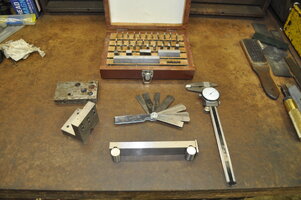
  • I spent a lot of time, 9 days, on the project primarily in research, making equipment and Toolwiz calibration. The actual alignment, once I knew what I was doing, took about 8 hours. It cost me just $12 for the Toolwiz. The large 800 lb-ft torque wrench is a loaner from Autozone. The other tools I already had, picture below:
  • Insert pic DSC_0001_01
  • DSC_0001_01.JPG

  • Here are the calibration tools
  • Insert pic DSC_0001_02
  • DSC_0001_02.JPG

  • It certainly would have been a lot easier to have an alignment shop do the job, but I did not know where to go or who to trust. I had all the tools so why not give it a try. I enjoyed the challenge, and learned something new. Knowledge is never wasted. Experience savored.


footnote

Derivation of Equation(b)

All parameters are defined in Post #1 as are the referenced equations eq(7) and eq(b).

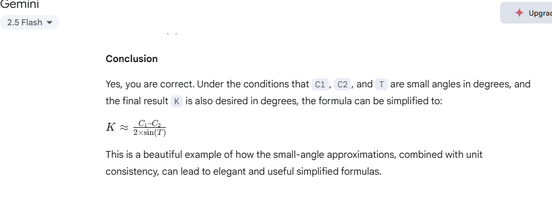
Google artificial intelligence, Gemini 2.5 Flash, was used to simplify the caster equation eq(7) to the simple form eq(b) commonly found on the internet. The question was posed:

Gemini question: (Can this formula, K = arctan((sinC1 – sinC2)/(sinT2 – sinT1) be simplified to, K = (C1 – C2) / (2 * sinT) if T1 = -T1 = abs(T), C1 and C2 are small angles less than 5 degrees).

It took several iterations to get the answer so I will paraphrase for readability

Gemini answer: Yes, under the given conditions, the formula can be simplified to the form.

Insert pic Sinplify1.PNG
Simplify1.png


Insert pic Sinplify2.PNG
Simplify2.png


Insert pic Sinplify3.PNGSimplify3.png


Insert pic Sinplify4.PNG
Simplify4.png


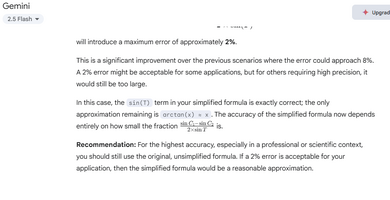
Key to using the formula is that C1, C2 and T are small angles. However, T is not a small angle being usually between 10 and 20 degrees. So a study was done to find practical angles used in automotive work that the formula can handle. Gemini was asked to calculate accuracy for various ranges of C1, C2 and T and found the formula to be in error over 8% if T was 10 degrees. So I fixed T at 20 degrees and asked again for an accuracy calculation. Note that Gemini is comparing results of eq(7) with the results of the simplified formula above.

Insert pic SinplifyAcc1.PNG
SimplifyAcc1.png


Insert pic SinplifyAcc2.PNGSimplifyAcc2.png


Insert pic SinplifyAcc3.PNG
SimplifyAcc3.png


The original formula Gemini is referring to is eq(7) in post #1. If you are working on a race car or chopper bike with unusual camber and caster angles, that formula should be used for accurate results. For the GMC Envoy, the simplified formula will suffice for my needs (2% of 5 degrees is only 0.1 degree).


Continued in Post 5
 
Post 5

  • RELATIVE MODE CAMBER MEASUREMENT


  • In this post, “Relative Mode” technique will be used to measure camber. This is a follow up of post 1 where “Absolute Mode” was used in the alignment process. Caster is measured in the same manner as described in post 1 but with camber C1 and C2 measured by relative technique described in this post.

  • Relative Mode Camber Measurement
  • To measure camber in relative mode, set Toolwiz on a straight surface of same incline of the front tires of the vehicle. Adjust the scale to zero using the leveling knob. Make note of which side (left or right) the Toolwiz base is towards. Camber can be measured so long as the Toolwiz base is orientated towards that same side. Now imagine the tires, in the picture below, have a negative camber (tops of tires tilt towards each other), Toolwiz will read negatively if its base is towards the tire, and positively when the base is away from the tire. The Toolwiz sign is inverted for those cases. The advantage of relative mode is it does not require a precision machinist level or absolute level calibration, but the camber jig must have pins long enough to accommodate Toolwiz inside the pins, and a straight bar will be required to set the relative tilt. Here is a picture to visualize the relative measurement technique:
  • Insert pic RelativeMode.JPG
  • RelativeMode.jpg

  • Camber Jig
  • The camber jig in post 1 was modified to have pins .50 diameter x 10 inch long drilled and tapped ¼-20 on one end and well rounded on the other end. The 2 pins length could be accurately matched with a caliper and set on the bar 17.5 inch O.C. with greater precision than the former arrangement. Toolwiz can now be mounted on either side of the jig bar so relative mode measurements are possible. The longer pins also offer more head comfort for gauge reading without fender interference.
  • Insert pic DSC_0001_01.png
  • 1752092353685.jpeg


  • Straight Edge
  • To make measurements in Relative mode, the camber gauge must be zeroed on the line of tilt between tires. Because the garage floor is not straight or level, A precision straight edge supported on two points will be required. If the straight edge is crooked, camber measurements will be inaccurate. See top figure in picture below. If the bar is parallel in the vicinity under Toolwiz, to an imaginary line between support points, then camber measurements will be accurate. See lower figure.
  • Insert pic: StrBarReq.png
  • StrBarReq.png


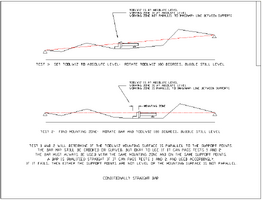
  • There are two tests for conditional straightness, test 1 and test 2. If a bar passes both tests then It is “conditionally” straight meaning the surface of the bar immediately underneath the level is parallel to an imaginary line connecting the support blocks. The tests are described in the picture below:
  • Insert pic: Test12.png
  • TEST12.png

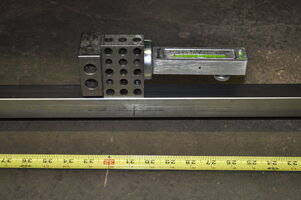
  • I used a steel tube 1.25 square x .06 wall x 72 long from a big box store. I checked it carefully for straightness against another bar in the store and checked again after rotating it 180 degrees. The two pieces stick together from the oil film. A good sign, but not a perfect one, of straightness. Tests 1 and 2 will determine if the bar is straight enough to use within the resolution capabilities of Toolwiz.

  • Test 1 confirms the Toolwiz tilting base is adjusted to absolute level. Set Toolwiz on the bar center to null bar sag. Adjust Toolwiz tilting base to level. Rotate 180 degrees and check if still level. If not adjust the bar tilt. Repeat until it can pass. In this manner, the Toolwiz tilting base is adjusted to absolute level. After test 1 passes, test 2 is performed with Toolwiz fixed on absolute level.

  • Test 2 determines the location on the bar is parallel to the imaginary line between the supports. If test 2 fails then move Toolwiz to a different location on the bar. Repeat test 2 until it passes. Repeat test 1 on the new location. The bar is “conditionally” straight when both test 1 and 2 pass.

  • To save time, I used a precision machinist level instead of Toolwiz (pictured below). A mini scissors jack from the laser level kit was used to adjust bar tilt. Support points are on the centers of the tire footprints. After each adjustment of the scissors table, I lifted and replaced the level to relieve hysteresis. The level was moved 2 inches fore and aft but only passed tests 1 and 2 when centered. The tests took a great deal of time and patience. The bar is marked with the position of the level and support points. The bar is now qualified as conditionally straight when used and supported on the same test points.
  • Insert pic: DSC_0002.PNG
  • DSC_0002.JPG

  • Insert pic DSC_0007.png
  • DSC_0007.JPG


  • CAMBER MEASUREMENT “RELATIVE MODE” PROCEDURE
  • 1. Mark the locations of the 4 tire footprints where measurements will be taken. Back the vehicle off the marked locations. Use a laser level to shim the rear tire footprints to the same height as the front ones. The vehicle must be level front to back but can be tilted left to right. An assortment of 12 x 12 inch plywood of varying thicknesses did the job. My garage floor sloped about an inch between front and rear footprints.
  • Insert pic DSC_0011.png
  • DSC_0011.JPG

  • 2. Set the straight bar on supports of exact equal height placed on the center of the front tire footprint. Use the same test mark locations on the straight bar. Place Toolwiz on the same location as the test level. Adjust the tilting scale to zero the bubble.
  • Insert pic DSC_0015.png
  • DSC_0015.JPG

  • Toolwiz is supported on a precision 123 shop block and weighted on the backside so it does not tip over. The shop block is perpendicular .0001 inch all sides. I have to trust the manufacturer on that point. Note, the straight bar is shown rotated 180 degrees from the previous pictures. The marks on this side shown are not valid. The floor is tilted about 1 degree, and Toolwiz zeroed via its tilting scale.
  • Insert pic DSC_0010.png
  • DSC_0010.JPG

  • 3. Toolwiz is transferred from the 123 block onto the camber jig.

  • 4. With 0 steering angle, the vehicle is moved forward to the center of the chalked footprints where Toolwiz was zeroed. Camber is measured with the camber jig. Toolwiz bubble readings are corrected according to the calibration table (see post 1). Readings are suffixed as follows g = gauge bubble location, c = table corrected value of tilt degrees.

  • Left front camber = -.62g = -.33c degrees

  • Right front camber = +1.00g = +.69c = -.69c degrees (sign reversed as Toolwiz base is away from tire on right side)

  • Insert pic: Interpolation.png
  • Interpolation.png


  • 5. Results compared approximately to the camber measurements taken in “absolute mode” in post 1 as previously discussed.


  • SUMMARY
  • For just checking if a vehicle is in alignment, relative mode has advantage of simplicity, especially if one has a conditionally straight bar on hand. However, if adjustment is required, working clearance off the floor is needed and that opens up other issues that make “absolute mode” more advantageous. Relative mode is also useful to double check absolute mode measurements since both use different baselines of reference.

 
Caster and camber are both adjustable by moving the position of the lower control arm in its pocket. The only 'tools' required are a prybar and small sledge or dead blow hammer. Moving the control arm towards the front or rear of the vehicle adjusts caster. Moving the control arm in our out in relation to vehicle centerline adjusts camber. Anybody who tells you they can't be adjusted doesn't know as much as they think they do. There are limits as to how far they can be adjusted, but adjusted they most certainly can be.
 
  • Like
Reactions: Camdo
On the TB, the only good alignment I ever got last year was from the dealer. Earlier this year the tire shop screwed it up and I had to return it 3 times but just because the steering wheel was off center.

My Caprice was an even worse adventure. The tire shop aligned it first. I was OK except he told me the rear couldn't be adjusted because the bolts were rusted (sound familiar?). Then brought it to the same dealer later. He aligned it front and back no problem but the steering wheel is off center but it does track straight. I should have brought it back but I didn't. Maybe I'll just turn each tie-rod equally to center the wheel.

Are all techs cockeyed or something? They can't put a steering wheel straight ahead while aligning it? You just can't win.
 
I took my 09 to a local shop for an alignment because of some cupping on my tires and it came out feeling worse than when I took it in. I read that 'most' shops only do toe adjustments anyway so thought I'd at least measure my toe in and see what what up. Apparently toe in is between 0 & 0.2 degrees which is about 1/16" to 1/32" between front and back. I built some 2 foot brackets from angle iron that bolted to the front rotors and I made slots and holders for 2 tape measures so I could measure the front and back dimensions while I adjusted 1 tie-rod. I jacket it up and supported on jack stands to load the suspension. Measured and found it was toed out which explained the offset steering wheel and pull to the right. Lots of adjusting (jack up/tires off/brackets on/adjust/tires on/test drive) to get it to track straight even though the steering wheel was off center. Driving it seemed to validate the right feel even when measurements seemed right. Finally once tracking was straight and no pull, I centered the steering wheel by turning each side tie-rods equal small amounts. I was surprised that only a 1/6 turn made a noticeable difference in the steering position. Now I will watch the tires for cupping but it tracks nicely and don't have the problems in handling described above so hopefully the caster and camber aren't too far out.
One mechanic told me that most shops appear to have reasonably priced alignments (for toe-in) only to get you in - then they find other parts that need to be replaced for of course more $$. It was a fun but labour intensive process - too bad the original alignment wasn't what I had expected. Probably should have taken it back.
 
  • Like
Reactions: Mooseman and Camdo
I think toe is best measured and checked after rolling the vehicle a few feet forward to get the correct squirm or preload on the suspension components. Instead of jack stands, a 16 foot elevated plank would do the trick. Measure toe, adjust, roll back 4 feet, roll forward 4 feet, check toe. Removing the tires disturbs the whole setup. The dimensions are tiny, and the components are springy.
 
I'm just happy that my Sierra is still good on the original factory alignment. I dread the day that it will need one. Too bad we can't go back to the factory for alignments :frown:
 
I think toe is best measured and checked after rolling the vehicle a few feet forward to get the correct squirm or preload on the suspension components. Instead of jack stands, a 16 foot elevated plank would do the trick. Measure toe, adjust, roll back 4 feet, roll forward 4 feet, check toe. Removing the tires disturbs the whole setup. The dimensions are tiny, and the components are springy.


I had the lower control arms rest on the jack stands so the suspension was loaded and not hanging free however your comment would explain why I had to adjust so many times to get it to track straight with no pulling. Agreed - the adjustments required are small.
 
  • Like
Reactions: Mooseman

Forum Statistics

Threads
24,252
Posts
648,433
Members
20,692
Latest member
Owen.Naughton