Post 1 of 5
DIY FRONT WHEEL ALIGNMENT
Keywords: Tire alignment, caster formula, caster derivation, caster equation, caster math, 850219, Toolwiz, caster-camber gauge, caster/camber, caster / camber, Caster – camber, caster-camber, SAI
Vehicle 2005 GMC Envoy, 4X4, SLT, 4.2L, coil spring suspension (short wheelbase)
Replaced 2 lower control arms, 2 upper control arms, left and right tie rods. Final positioning of the lower control arms was set at furthest inward position. Alignment was going to be way off factory specification. Plan was to purchase new tires and have the tire shop do a professional alignment.
In the past, my vehicle was aligned three times by a trusted tire shop. The first time, 7 years ago, after purchasing new tires, the alignment report was good and my vehicle drove great. The second time, 6 years ago, after replacing ball joints and tie rods, the alignment report had 1 red box on it. They said camber was not adjustable, it’s the way things are, nothing to be alarmed about. Not knowing any better I accepted their statement. After all they were the experts and I trusted them. The third time, 2 years ago, after replacing tie rods, the alignment report had a lot of red on it. They said “The bolts were rusted and could not adjust camber and caster. It’s nothing to worry about”. Now I know something is wrong since the last time they said it was not adjustable and now they say its rusted inferring it could be adjusted, but not practical to do so. My vehicle is 20 years old and it probably is rusted, so I accepted their excuse.
Now at present, I have replaced the lower control arms and found the bolts were not rusted, and the chassis pockets the arms fit into were not rusted. I know now, the tire shop I had dealt with for the last 7 years was being deceitful, as they told me it was rusted and not adjustable. I will not go there again. There should be no excuse for another shop to adjust caster and camber.
I searched for tire shops that do alignments and found they all looked the same. So I went to a big box shop that advertised on TV and went to the back to talk directly to the alignment guy. I pointed to my Envoy and asked if he had experience aligning that model. He said many times, but this shop did not have many tools and I should go to another branch 20 miles away where he was transferred from. Okay, I went to that branch and told them of the recommendation and they knew that guy well. It was good luck that I was talking to their alignment guy at the front counter. He told me the Envoy will be brought to factory specification and I would not have to pay if it was not. He was trained to work on my vehicle, and he had the tools to do the job. This is great, I thought and made an appointment for new tires and alignment.
During the alignment, I walked in back to see it being performed. I asked the guy doing the work (the same guy who took my order and made all the promises and assertions) if he had the tools to work with 200 lb-ft of torque. He told me he “Had no problems with the job” and not to worry. The laser beams were flashing and it all looked very professional and exacting. The sign said “No customers in the service bay”. I went back to the waiting room.
I get the call, “all done”, and the desk clerk says “Wow it must have been way out of align. Looks good now”. He runs thru the things and features I purchased and motions me to pay the total and so I do. Then I glanced at the alignment report. 1 red box, Left Camber +1.00 . “It’s out of spec” I said. “Oh, It’s not adjustable. Nothing to worry about. If it was a problem he would have fixed it”, he said. The only thing they adjusted was toe. Everything else was untouched. The control arms were where I left them, at maximum inward positions from the install.
I left the tire shop disappointed. My vehicle does not drive well. It is touchy to dig into a curve at the touch of the steering wheel. I had been had. Thinking of what was said, they had not exactly lied to me. They aligned ‘toe’ to factory specification and he had the tools to do it. Deceitful, but not a lie. I am no match against experts of deception. I was beaten.
I resolved to align the vehicle myself. I want to know the true state of alignment and not waste any more money. I looked forward to the challenge. I will do the best job I can with common tools and for low cost . I began reading up on the subject. Watched YouTube videos and read forums and manuals and scanned merchant’s tool offerings.
THE FORMULA FOR CASTER
There are several formulas and procedures floating on the internet for determining caster angle. To determine which is correct, I must see a complete derivation using first principles of engineering. An excellent study titled “Steering Geometry and Caster Measurement”, Daniel B. January, Hunter Engineering Company, Bridgeton, Missouri, 1/30/1985. Has been reprinted with permission from the SAE Technical Paper Series 850219.
https://disco3.co.uk/gallery/albums/userpics/24543/steering-geometry-and-caster-measurement[1].pdf
In the paper, we can see the derivation of the caster angle formula and a procedure to use it.
From the paper
Definitions: K = caster angle, T1 = steering angle from thrust line of vehicle defined as negative when front of tire rotated outward, T2 = steering angle from TL defined as positive when front of tire is rotated inward, T = T2 = -T1 (the symmetrical steering angle without regard for sign), All variables K, C1, C2, T1, T2, T are in degrees. The caster turn is steering from (straight ahead)T0 to T1 to T2.
K = arctan((sinC1 – sinC2)/(sinT2 – sinT1) eq(7)
Equation(7) is the exact equation for Caster Angle with the limitation that camber angles are small (less than 2 degrees), and the caster turn is symmetric about the thrust line.
If slight deviation from exact is allowed, equation(7) can be further simplified to:
K = 180 / pi *((C1 – C2) / (T2 - T1)) eq(8)
Another formula commonly found on the internet is also a simplification of Eq(7):
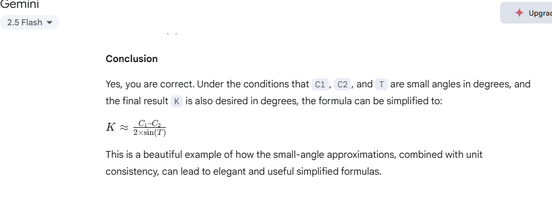
K = (C1 – C2) / (2 * sinT) eq(a)
The derivation of eq(a) can be found in a following post as a footnote.
All three formulas give essentially the same answer within the bounds of common vehicle alignment angles.
Example1
C1 = +1.55 C2 = -1.25 T1=-20 T2 = +20
Eq(7) K = arctan((sin(+1.55) – sin(-1.25))/(sin(+20) –sin(-20)) = 4.085
Eq(8) K= 180 / pi * ((+1.55 – (-1.25))/(+20 –(- 20)) = 4.010
Eq(a) K= (+1.55 – ( -1.25) / (2 * sin(20)) = 4.093
Example 2
C1 = 0.75 C2 = -0.60 T1=10 T2 = -10
Eq(7) K = 3.881
Eq(8) K=3.867
Eq(a) K=3.887
The three equations give essentially the same result for small camber angles commonly within the steering range.
Equations (8) and eq(a) can be simplified further to If the steering angle is always going to be +/- 20 degrees symmetrical:
Eq(8) simplifies to:
K = 180/pi*(C1-C2)/(T2-T1) = 180/pi*(C1-C2)/(20--20)
K = 1.432 * (C1 - C2) Eq(8a)
And eq(a) simplifies to
K = (C1 – C2) / (2 * sinT) = (C1 – C2) / (2 * sin20) = (C1-C2) / .6840
K = 1.462 * (C1 – C2) Eq(b)
Either equation eq(8a) or eq(b) can be used for vehicle alignment with limitations: Steering angle +/- 20 degrees is symmetric to thrust line, small camber angles less than 2 degrees are encountered in the caster turn. I chose eq(b) to use in my alignment as it seems to have a very slight edge in accuracy for the angles Envoy uses.
Alignment procedure:
1. At 0 degree toe measure camber. Toe at zero degrees is measured from the thrust line which is the stance of the vehicle tracking forward in a straight line.
2. Turn left front wheel T1 = -20 degrees as in making a left hand turn. Front of tire faces outward.
3. Measure camber C1.
4. Turn wheel back to 0 toe.
5. Turn Left wheel T2 = + 20 degrees as in making a right turn. Front of tire faces inward.
6. Measure camber C2.
7. Return wheel to 0 toe.
8. Calculate left front caster: K = (C1 – C2) * 1.462
9. Repeat for right side.
10. At 0 degree toe measure camber.
11. Turn right front wheel T1 = -20 degrees as in making a right hand turn. Front of tire faces outward.
12. Measure camber C1.
13. Turn wheel back to 0 toe.
14. Turn right wheel T2 = + 20 degrees as in making a left turn. Front of tire faces inward.
15. Measure camber C2.
16. Return wheel to 0 toe.
17. Calculate right front caster: K = (C1 – C2) * 1.462
DIY FRONT WHEEL ALIGNMENT
Keywords: Tire alignment, caster formula, caster derivation, caster equation, caster math, 850219, Toolwiz, caster-camber gauge, caster/camber, caster / camber, Caster – camber, caster-camber, SAI
Vehicle 2005 GMC Envoy, 4X4, SLT, 4.2L, coil spring suspension (short wheelbase)
Replaced 2 lower control arms, 2 upper control arms, left and right tie rods. Final positioning of the lower control arms was set at furthest inward position. Alignment was going to be way off factory specification. Plan was to purchase new tires and have the tire shop do a professional alignment.
In the past, my vehicle was aligned three times by a trusted tire shop. The first time, 7 years ago, after purchasing new tires, the alignment report was good and my vehicle drove great. The second time, 6 years ago, after replacing ball joints and tie rods, the alignment report had 1 red box on it. They said camber was not adjustable, it’s the way things are, nothing to be alarmed about. Not knowing any better I accepted their statement. After all they were the experts and I trusted them. The third time, 2 years ago, after replacing tie rods, the alignment report had a lot of red on it. They said “The bolts were rusted and could not adjust camber and caster. It’s nothing to worry about”. Now I know something is wrong since the last time they said it was not adjustable and now they say its rusted inferring it could be adjusted, but not practical to do so. My vehicle is 20 years old and it probably is rusted, so I accepted their excuse.
Now at present, I have replaced the lower control arms and found the bolts were not rusted, and the chassis pockets the arms fit into were not rusted. I know now, the tire shop I had dealt with for the last 7 years was being deceitful, as they told me it was rusted and not adjustable. I will not go there again. There should be no excuse for another shop to adjust caster and camber.
I searched for tire shops that do alignments and found they all looked the same. So I went to a big box shop that advertised on TV and went to the back to talk directly to the alignment guy. I pointed to my Envoy and asked if he had experience aligning that model. He said many times, but this shop did not have many tools and I should go to another branch 20 miles away where he was transferred from. Okay, I went to that branch and told them of the recommendation and they knew that guy well. It was good luck that I was talking to their alignment guy at the front counter. He told me the Envoy will be brought to factory specification and I would not have to pay if it was not. He was trained to work on my vehicle, and he had the tools to do the job. This is great, I thought and made an appointment for new tires and alignment.
During the alignment, I walked in back to see it being performed. I asked the guy doing the work (the same guy who took my order and made all the promises and assertions) if he had the tools to work with 200 lb-ft of torque. He told me he “Had no problems with the job” and not to worry. The laser beams were flashing and it all looked very professional and exacting. The sign said “No customers in the service bay”. I went back to the waiting room.
I get the call, “all done”, and the desk clerk says “Wow it must have been way out of align. Looks good now”. He runs thru the things and features I purchased and motions me to pay the total and so I do. Then I glanced at the alignment report. 1 red box, Left Camber +1.00 . “It’s out of spec” I said. “Oh, It’s not adjustable. Nothing to worry about. If it was a problem he would have fixed it”, he said. The only thing they adjusted was toe. Everything else was untouched. The control arms were where I left them, at maximum inward positions from the install.
I left the tire shop disappointed. My vehicle does not drive well. It is touchy to dig into a curve at the touch of the steering wheel. I had been had. Thinking of what was said, they had not exactly lied to me. They aligned ‘toe’ to factory specification and he had the tools to do it. Deceitful, but not a lie. I am no match against experts of deception. I was beaten.
I resolved to align the vehicle myself. I want to know the true state of alignment and not waste any more money. I looked forward to the challenge. I will do the best job I can with common tools and for low cost . I began reading up on the subject. Watched YouTube videos and read forums and manuals and scanned merchant’s tool offerings.
THE FORMULA FOR CASTER
There are several formulas and procedures floating on the internet for determining caster angle. To determine which is correct, I must see a complete derivation using first principles of engineering. An excellent study titled “Steering Geometry and Caster Measurement”, Daniel B. January, Hunter Engineering Company, Bridgeton, Missouri, 1/30/1985. Has been reprinted with permission from the SAE Technical Paper Series 850219.
https://disco3.co.uk/gallery/albums/userpics/24543/steering-geometry-and-caster-measurement[1].pdf
In the paper, we can see the derivation of the caster angle formula and a procedure to use it.
From the paper
Definitions: K = caster angle, T1 = steering angle from thrust line of vehicle defined as negative when front of tire rotated outward, T2 = steering angle from TL defined as positive when front of tire is rotated inward, T = T2 = -T1 (the symmetrical steering angle without regard for sign), All variables K, C1, C2, T1, T2, T are in degrees. The caster turn is steering from (straight ahead)T0 to T1 to T2.
K = arctan((sinC1 – sinC2)/(sinT2 – sinT1) eq(7)
Equation(7) is the exact equation for Caster Angle with the limitation that camber angles are small (less than 2 degrees), and the caster turn is symmetric about the thrust line.
If slight deviation from exact is allowed, equation(7) can be further simplified to:
K = 180 / pi *((C1 – C2) / (T2 - T1)) eq(8)
Another formula commonly found on the internet is also a simplification of Eq(7):
K = (C1 – C2) / (2 * sinT) eq(a)
The derivation of eq(a) can be found in a following post as a footnote.
All three formulas give essentially the same answer within the bounds of common vehicle alignment angles.
Example1
C1 = +1.55 C2 = -1.25 T1=-20 T2 = +20
Eq(7) K = arctan((sin(+1.55) – sin(-1.25))/(sin(+20) –sin(-20)) = 4.085
Eq(8) K= 180 / pi * ((+1.55 – (-1.25))/(+20 –(- 20)) = 4.010
Eq(a) K= (+1.55 – ( -1.25) / (2 * sin(20)) = 4.093
Example 2
C1 = 0.75 C2 = -0.60 T1=10 T2 = -10
Eq(7) K = 3.881
Eq(8) K=3.867
Eq(a) K=3.887
The three equations give essentially the same result for small camber angles commonly within the steering range.
Equations (8) and eq(a) can be simplified further to If the steering angle is always going to be +/- 20 degrees symmetrical:
Eq(8) simplifies to:
K = 180/pi*(C1-C2)/(T2-T1) = 180/pi*(C1-C2)/(20--20)
K = 1.432 * (C1 - C2) Eq(8a)
And eq(a) simplifies to
K = (C1 – C2) / (2 * sinT) = (C1 – C2) / (2 * sin20) = (C1-C2) / .6840
K = 1.462 * (C1 – C2) Eq(b)
Either equation eq(8a) or eq(b) can be used for vehicle alignment with limitations: Steering angle +/- 20 degrees is symmetric to thrust line, small camber angles less than 2 degrees are encountered in the caster turn. I chose eq(b) to use in my alignment as it seems to have a very slight edge in accuracy for the angles Envoy uses.
Alignment procedure:
1. At 0 degree toe measure camber. Toe at zero degrees is measured from the thrust line which is the stance of the vehicle tracking forward in a straight line.
2. Turn left front wheel T1 = -20 degrees as in making a left hand turn. Front of tire faces outward.
3. Measure camber C1.
4. Turn wheel back to 0 toe.
5. Turn Left wheel T2 = + 20 degrees as in making a right turn. Front of tire faces inward.
6. Measure camber C2.
7. Return wheel to 0 toe.
8. Calculate left front caster: K = (C1 – C2) * 1.462
9. Repeat for right side.
10. At 0 degree toe measure camber.
11. Turn right front wheel T1 = -20 degrees as in making a right hand turn. Front of tire faces outward.
12. Measure camber C1.
13. Turn wheel back to 0 toe.
14. Turn right wheel T2 = + 20 degrees as in making a left turn. Front of tire faces inward.
15. Measure camber C2.
16. Return wheel to 0 toe.
17. Calculate right front caster: K = (C1 – C2) * 1.462
- Avoid hysteresis error by approaching the target steering angle from the same rotation sense. For example in step 2, overshoot the -20 degree target and then return clockwise to -20. Then is step 5 turn clockwise to +20 degrees without overshoot. That will load the suspension components consistently so C1 - C2 is accurate without hysteresis error.